
Date: June 16, 2026
Category: Research Announcements / Regional Dynamics
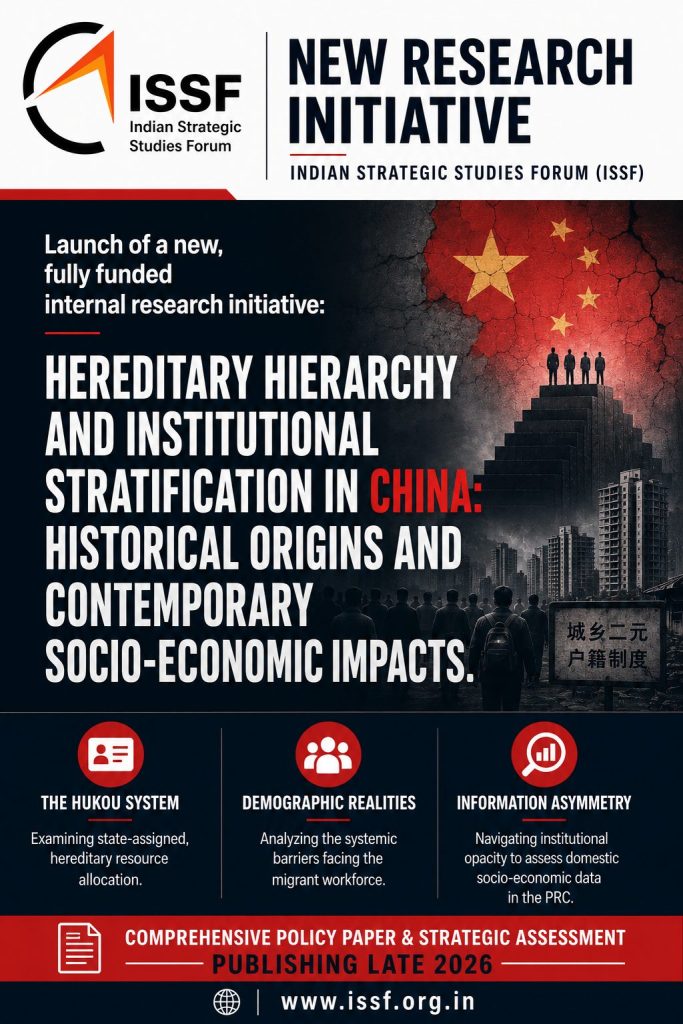
The Indian Strategic Studies Foundation (ISSF) is pleased to announce the launch of a comprehensive, internally funded research initiative titled “Hereditary Hierarchy and Institutional Stratification in China: Historical Origins and Contemporary Socio-Economic Impacts.”
Conducted by ISSF’s in-house team of political sociologists, demographers, and regional analysts, this upcoming study will provide an objective, data-driven assessment of state-engineered social stratification in the People’s Republic of China (PRC).
Analyzing domestic socio-economic dynamics in the PRC often requires navigating significant information asymmetry and state-directed data environments. This initiative aims to bridge that analytical gap, mapping the structural fault lines that directly influence China’s long-term domestic stability, economic trajectory, and labor market resilience.
Contextualizing the Study
While contemporary social analysis frequently examines hereditary division through regional or cultural lenses, the Chinese state has historically utilized, and continues to maintain, highly rigid institutional frameworks to stratify its population. This study moves beyond official state narratives to examine the structural mechanics of modern Chinese society across three primary analytical pillars:
- Historical Precedents of State-Enforced Stratification: Tracing the lineage of institutionalized inequality from the Imperial era to the modern state. The study analyzes traditional legal and ideological divisions—specifically the boundaries between liangmin (“good people”) and jianmin (“mean people” or the legally entrenched underclass)—demonstrating how early statecraft established the precedent for occupational rigidity.
- The Hukou System as a Hereditary Stratifier: A rigorous evaluation of the post-1950s Hukou (household registration) system. ISSF analysts will evaluate how the rigid binary division between agricultural (rural) and non-agricultural (urban) designations functions as a structural equivalent to hereditary tiering, binding citizens to a predetermined socio-economic status at birth and limiting geographic mobility.
- Contemporary Demographic Impacts and Citizenship Stratification: Evaluating the systemic barriers facing the Nongmingong (rural-to-urban migrant worker) class. The study analyzes the macroeconomic implications of “citizenship stratification,” wherein millions of urban workers are systematically restricted from accessing local state-funded healthcare, public education, and housing subsidies, directly impacting China’s domestic consumption goals.
Strategic Significance
Accurate strategic forecasting requires a granular understanding of an actor’s internal socio-economic vulnerabilities. By examining the institutional mechanisms that enforce stratification in China, this study aims to equip global policymakers, economic strategists, and defense analysts with a realistic, baseline assessment of the PRC’s internal cohesion.
Methodology and Publication
To counteract state-directed data limitations, the ISSF research team is leveraging large-scale, longitudinal public datasets—including the China Family Panel Studies (CFPS) and the Chinese General Social Survey (CGSS)—alongside econometric modeling and historical policy analysis.
The initiative is currently underway. ISSF anticipates publishing the final, comprehensive policy paper and an accompanying executive summary in Late 2026.
Stay Informed
To receive early access to the publication, invitations to upcoming panel discussions, or to connect with our lead research team, please contact our Office of Communications at [email protected].

