
The Origins and the Blood of Empires (Shang to Qin)
The history of the Chinese state is written on the bones of women. To understand the fundamental relationship between the ruling apparatus and female biology, one must start in the dirt of the Yellow River valley.
The ancient practices of xunzang (accompanying burial) and renxun (human sacrifice) established the baseline operating procedure of the empire: a woman’s body was not her own. It was a literal currency to be spent for the comfort of male rulers in the afterlife.
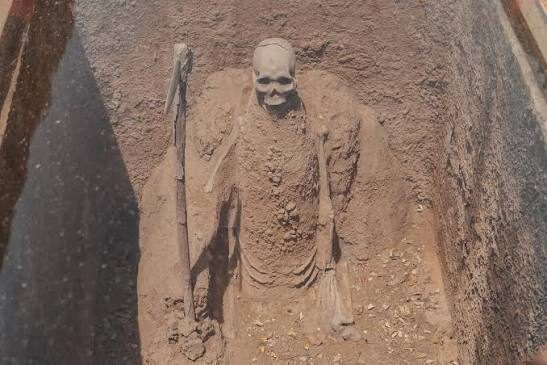
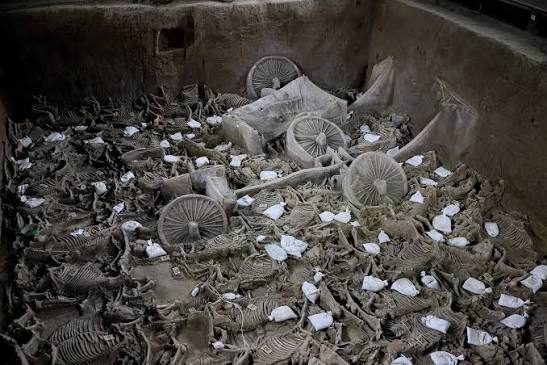
At the Mausoleum of Late Shang Kings at Houjiazhuang, archaeologists excavated the remains of 164 individuals – most of them young, many of them women – slaughtered to line the tomb of a single monarch. This was not an act of sporadic violence; it was an industrial-scale bureaucratic operation. The Shang state functioned on the premise that power extended past death, and the retinue required to maintain that power had to be violently compelled to follow.
Centuries later, the Qin Dynasty perfected the machinery of autocracy. When Qin Shi Huang, the architect of the first unified Chinese empire, died in 210 BCE, his successor, Huhai (Qin Er Shi), issued a sweeping decree. He ordered that all of his father’s imperial consorts and concubines who had not borne children be sealed inside the sprawling necropolis.
The historian Sima Qian recorded the visceral reality of this execution: the weeping and screaming shook the earth. These women were not killed cleanly. Archaeological evidence from the burial site shows skeletons scattered in unnatural, contorted positions in the passageways.
They were driven underground, the heavy stone doors were rolled shut, and they were left to suffocate or starve in the pitch black. To ensure the tomb’s secrets remained hidden, the artisans who built the mechanical traps and dug the chambers were sealed in alongside them.
The Gruesome Mechanics and the Ming Revival
The historical record often sanitizes these deaths with passive language, stating that women “accompanied” the emperor. The physical reality was a bloodbath of state-mandated terror. Execution methods were clinical and heavily systematized.
For the highest-ranking concubines, the state employed mercury poisoning. Women were administered a sedative in their tea. Once unconscious, the tops of their skulls were sliced open in a cross formation, and liquid mercury was poured directly into the wound. The metal seeped into the nervous system, inducing massive toxic shock while simultaneously embalming the corpse from the inside out to preserve its aesthetic value for the dead emperor. Others were simply poisoned with arsenic-laced wine.
While the sheer scale of xunzang waned after the Han Dynasty, it was violently resurrected by the Ming Dynasty. The Hongwu Emperor (Zhu Yuanzhang), the founder of the Ming, formally reinstated the mass execution of concubines to project absolute power. When he died in 1398, a royal decree mandated the deaths of 46 childless concubines.
The mechanics were brutally efficient. The women were herded into a communal hall where 46 “Grand Tutor’s chairs” were arranged. Above each chair hung a seven-inch rope. The women were forced to step onto the chairs and hang themselves simultaneously. Those who hesitated were assisted by palace eunuchs.
The psychological torture of living in the Ming harem meant spending years anticipating the day the emperor’s pulse stopped, knowing it would trigger an immediate death sentence. This state-sanctioned slaughter within the Forbidden City was not officially abolished until 1464, when the dying Tianshun Emperor – an otherwise incompetent ruler – issued a final will prohibiting the burial of living concubines and palace maids.
The Ideological Torture: The Cult of Widow Chastity
When the physical interment of living women fell out of favor, the state did not relinquish control over the female body; it simply outsourced the violence to the family unit.
The ideological groundwork was laid during the Song Dynasty with the rise of Neo-Confucianism. Philosophers like Cheng Yi and Zhu Xi weaponized morality. Cheng Yi famously declared, “To starve to death is a small matter, but to lose one’s chastity is a great matter” (餓死事小,失節事大).
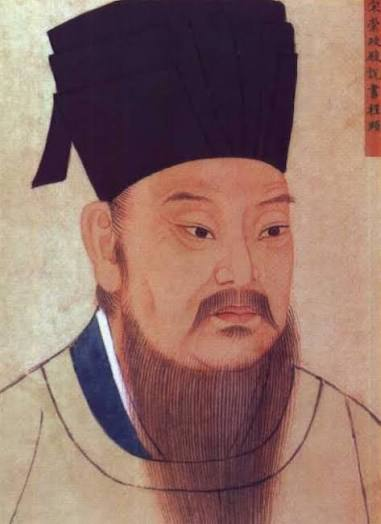
What began as elite philosophical discourse mutated into the Cult of Widow Chastity – a severe societal demand that widows remain celibate or, preferably, kill themselves to demonstrate ultimate loyalty to their deceased husbands.
During the Qing Dynasty, while the Kangxi Emperor formally banned the physical sacrifice of slaves and retainers in 1673, the cult of the jiefu (chaste widow) and lienv (heroic woman) reached its zenith. The state bureaucracy offered irresistible perverse incentives. A family that produced a lienv who committed suicide after her husband’s death was rewarded with tax exemptions, elevated social status, and the government-funded construction of an ornate stone arch, or paifang, in their village.
The economic reality was devastating. In a deeply impoverished agrarian society, a living widow was a financial drain who threatened to take her dowry away if she remarried. A dead widow, however, was a highly lucrative asset. Families actively coerced, bullied, and starved their daughters-in-law into hanging themselves, swallowing gold, or jumping into wells.
The state framed this as ultimate moral purity; in practice, it was state-subsidized murder executed by in-laws. The claustrophobia was absolute: a woman’s greatest, most celebrated achievement in society was her own corpse.
The bureaucratic machinery of death relied on two specific classifications: xunfu (suicide for a husband) and xunjie (suicide to preserve chastity). To ensure the population viewed these acts as moral triumphs rather than gruesome tragedies, the state tightly controlled the visual narrative.
In mass-produced moral tracts like the Lienv Zhuan (Biographies of Exemplary Women) and local provincial gazetteers, the visceral horror of suicide was systematically erased. Woodblock prints depicting xunfu never showed the blackened faces of asphyxiation or the emaciated bodies of starved teenagers.
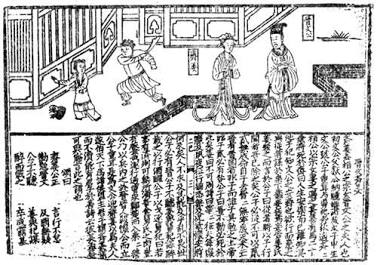
Instead, women were illustrated in pristine robes, calmly tying a silk noose or gracefully stepping into a courtyard well while approving ancestors looked on. The blood and convulsions were scrubbed from the record, replacing the agonizing reality of coerced death with a serene, sanitized propaganda that taught generations of girls that the most beautiful thing they could be was dead.
The Illusion of Liberation: Bride Suicides in the Republic and the PRC
Even as the Qing dynasty collapsed and the stone chastity arches crumbled, the machinery of rural captivity endured seamlessly into the 20th century. During the Republican era of the 1920s and 1930s, the traditional red bridal palanquin frequently functioned as a mobile execution chamber. Women subjected to forced marriages routinely concealed razor blades or raw opium paste in their embroidered wedding garments, slitting their wrists or swallowing the lethal narcotic while being carried by porters to the villages of their new owners.
Decades later, under the supposedly liberated banner of the People’s Republic, this epidemic of bride suicide merely industrialized. Throughout the 1980s and 1990s, rural China held the devastating distinction of being the only region on earth where female suicide rates vastly outstripped male rates.
Because local CCP cadres routinely turned a blind eye to domestic abuse and the rampant trafficking of rural women, trapped brides weaponized the only asset they still controlled: their own destruction. Bypassing the ropes and courtyard wells of the imperial era, these young women drank lethal doses of Paraquat and organophosphate fertilizers – dying in agonizing, convulsing spasms on the dirt floors of the very state-run agricultural communes that claimed to have emancipated them.
The Modern Echoes: The CCP and the State-Owned Body
It is a core tenet of Chinese Communist Party mythology that the revolution eradicated the “man-eating” feudalism of the past, liberating women from the crushing weight of imperial patriarchy. The early 20th century did see fierce resistance – during the May Fourth Movement in 1919, intellectuals viciously documented the lingering epidemic of rural widow suicides.
A famous 1919 incident in Changsha, where a young woman named Zhao Wuju slit her own throat in her bridal chair to escape an arranged marriage, prompted a young Mao Zedong to write furious essays condemning the patriarchal system that drove women to the blade.
Yet, examining the CCP’s actual governance reveals not a break from the imperial mindset, but its ultimate, technologically advanced evolution. The premise remains identical: the female body is a public utility, a macroeconomic lever to be pulled by the men in the capital.
In the late 20th century, this manifested as the One-Child Policy. For over three decades, the state seized absolute jurisdiction over the womb. Family planning officials operated with the same ruthless bureaucratic efficiency as the Ming eunuchs. In the 1980s and 1990s, the state monitored women’s menstrual cycles in workplaces and villages.
Women who became pregnant without a state-issued birth quota were hunted down, often dragged from their beds in the middle of the night.
They were strapped to operating tables and subjected to forced abortions, sometimes late in the third trimester, and immediately sterilized without their consent. The resulting demographic slaughter – millions of aborted female fetuses discarded because the state-induced quota system forced families to prioritize male heirs – is the direct ideological descendant of the mass graves at Houjiazhuang. The state dictated who lived, who died, and who was allowed to be born.
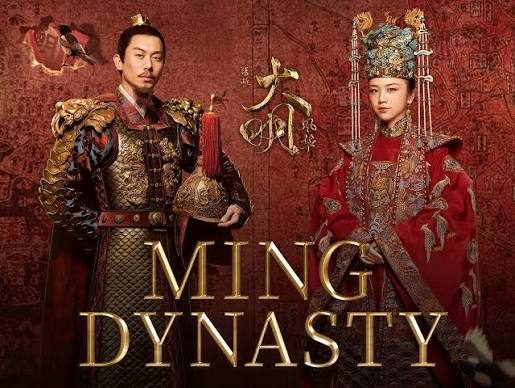
Today, the CCP pushes a hyper-nationalistic revival of “traditional Chinese culture.” State-approved, big-budget television dramas romanticize the Ming and Qin courts, obsessing over the silk robes and palace intrigue while deliberately whitewashing the mountains of female corpses those empires were built upon. The emperors who ordered women sealed in tombs are portrayed as complex, heroic state-builders.
Simultaneously, the demographic collapse engineered by the One-Child Policy has triggered a new mandate. The state no longer requires women to stop breeding; it demands they start. The aggressive stigmatization of unmarried, educated professionals as shengnu (“leftover women”), the systematic crushing of the #MeToo movement, and the silencing of modern feminists are not isolated civil rights abuses. They are the panicked reactions of a state realizing it is losing control of its primary biological resource.
From the asphyxiated concubines of Qin Shi Huang to the starved widows of the Qing, and from the forced abortions of the 1990s to the forced domesticity of today, the throughline is unbroken. The architecture of power in China has always required the subjugation of the female body. The methods simply transitioned from the rope and the sealed tomb to the surgical clamp and the algorithmic censor.
(This paper is part of our comprehensive research initiative titled “Hereditary Hierarchy and Institutional Stratification in China: Historical Origins and Contemporary Socio-Economic Impacts.”)