By Yash Nitin Sapre
There are two mistakes a civilisation can make when it studies the fire gathering at its gates. The first is to see conspiracy in every flame. The second is to wait until the palace is burning before admitting there was a pattern.
India today stands between these two errors.
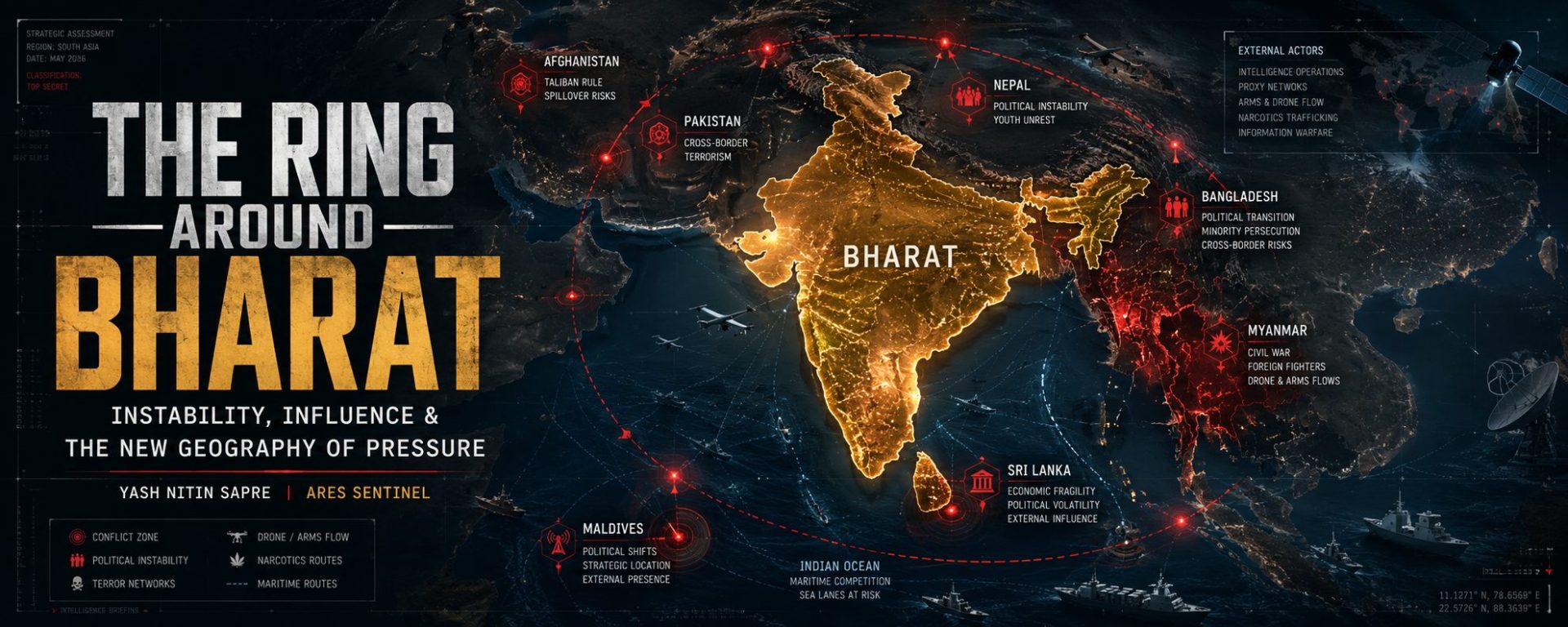
Across its neighbourhood, the map is changing. Myanmar is trapped in civil war. Bangladesh has passed through a political rupture and continues to sit on a fragile fault line. Nepal remains vulnerable to street movements, youth frustration and chronic instability. Sri Lanka is recovering from collapse but remains exposed to debt, dependency and external influence. The Maldives continues to drift between domestic politics and great-power courtship. Pakistan remains a permanent theatre of hostility and internal dysfunction. Afghanistan, under Taliban control, continues to cast a long shadow through Pakistan and the wider jihadist ecosystem.
Taken separately, each crisis has its own explanation. Every country has its own history, failures, elites, rebellions and grievances. No serious analyst should flatten these complexities into a single grand theory. But strategy is not the art of studying events in isolation. Strategy is the discipline of understanding cumulative effect.
And the cumulative effect is clear.
India is increasingly surrounded by instability.
Whether this is coordinated or coincidental, organic or encouraged, domestic or externally exploited, the outcome for New Delhi is the same. The Indian state must now operate in a neighbourhood where volatility itself has become a weapon.
The phrase “ring of chaos” recently entered public discussion after former NSG commando and self-described former RAW operative Lucky Bisht alleged that Western actors, including the United States and NATO-linked networks, were cultivating instability around India, particularly through Myanmar. His remarks deserve neither blind acceptance nor fashionable dismissal. They emerged through a Russian-state-affiliated platform, which means source scrutiny is necessary. But the claim touches a deeper strategic anxiety that cannot be waved away merely because the messenger is inconvenient.
Great powers have always used peripheries to pressure rising powers.
The British Empire did it during the Great Game. The United States and Soviet Union did it throughout the Cold War. China does it today through infrastructure, debt, trade dependency, elite capture and dual-use strategic access. No great power admits to surrounding a rival. It speaks instead of partnerships, democracy, development, humanitarian support, counterterrorism, maritime cooperation or regional stability. The language changes. The method remains ancient.
Pressure is rarely applied at the centre first. It is applied at the edges.
Myanmar is now the most dangerous edge.
Since the 2021 military coup, Myanmar has ceased to function as a normal state. It has become a fragmented battlefield of junta forces, ethnic armed organisations, resistance groups, smugglers, drones, narcotics routes, foreign volunteers, intelligence interests and private networks. For India, this is not a distant Southeast Asian tragedy. Myanmar shares a 1,643 kilometre border with India’s Northeast. The terrain is porous, the ethnic linkages are real, and the security consequences do not respect colonial lines drawn on maps.
The March 2026 arrest of American national Matthew VanDyke and six Ukrainian nationals by India’s National Investigation Agency brought this danger into sharp relief. The allegation was not merely that foreigners had entered restricted areas without permits. Indian agencies reportedly examined cross-border movement into Myanmar, contact with ethnic armed groups, possible drone training, jamming equipment and suspected arms-related activity. Even if the most dramatic interpretations remain unproven, the core fact is grave enough: foreign actors were allegedly operating through India’s sensitive northeastern corridor into a conflict zone bordering India.
That should disturb every serious national security mind in the country.
The issue is not whether every foreigner in Myanmar is part of an anti-India plot. That would be lazy thinking. The issue is that Myanmar’s war has created an open marketplace for military skills, drones, arms, logistics and influence. Once such ecosystems mature, they rarely remain obedient to the intentions of their original sponsors. Afghanistan proved this. Syria proved this. Libya proved this. Ukraine has proved how rapidly battlefield technologies and foreign volunteer networks can globalise.
A drone tactic taught in one valley does not remain in that valley. A smuggling route opened for one insurgency can later serve another. A relationship formed between armed groups, contractors and intelligence-linked actors can mutate into a network no ministry fully controls.
This is how instability travels.
The Northeast sits at the centre of this danger. Manipur, Mizoram, Nagaland and Arunachal Pradesh are not peripheral spaces. They are civilisational gateways, security frontiers and strategic corridors into Southeast Asia. The old habit of treating the Northeast as a distant borderland is obsolete. In the new Indo-Pacific geography, it is one of India’s most important theatres.
The Golden Triangle’s narcotics economy, Myanmar’s civil war, illegal arms flows, refugee movements, ethnic solidarities and drone proliferation now intersect dangerously close to Indian territory. Add to this the existing wounds of Manipur, the fragility of border management and the growing sophistication of non-state actors, and the picture becomes unmistakable. India’s eastern frontier is not merely a border. It is a pressure chamber.
Bangladesh is the second great variable.
For years, India’s security establishment benefited from a relatively stable equation in Dhaka. Cooperation on counterterrorism, connectivity and border management improved considerably under Sheikh Hasina. That equation has now changed. Bangladesh’s political transition after the 2024 upheaval opened space for uncertainty, factional repositioning and ideological contestation. The rise of new political forces, the return of older ones and the continued vulnerability of minorities have made Bangladesh a country India must watch with sobriety rather than nostalgia.
Bangladesh is not just another neighbour. It wraps around India’s Northeast and sits at the mouth of the Bay of Bengal. Its internal stability directly affects migration, radicalisation, trade, intelligence operations and maritime security. If Bangladesh becomes hostile, unstable or vulnerable to deeper external manipulation, India’s eastern flank becomes exponentially more complicated.
The question is not whether Dhaka must agree with New Delhi on every issue. Sovereign nations will pursue their own interests. The question is whether Bangladesh remains a stable partner or becomes another arena where domestic grievance is converted into geopolitical leverage.
The history of the subcontinent teaches us that ideological radicalisation, when mixed with economic uncertainty and foreign patronage, rarely remains confined within borders. India has paid for this lesson before. It cannot afford to relearn it.
Nepal presents a quieter but equally serious challenge.
There is no civil war in Nepal, no dramatic collapse, no visible enemy massing at the border. That is precisely why many ignore it. But instability does not always arrive with explosions. Sometimes it arrives as unemployment, failing institutions, restless youth, coalition breakdowns and a growing public contempt for political elites.
Nepal’s open border with India is both a civilisational asset and a security vulnerability. For centuries, the movement of people across this frontier has been natural, intimate and mutually beneficial. But openness also creates opportunities for smuggling, radical networks, intelligence penetration and political contagion. When street movements become the preferred language of political change, external actors do not need to create unrest. They only need to learn how to ride it.
This is the modern method. Create nothing. Amplify everything.
Sri Lanka and the Maldives extend this pressure into the maritime domain.
Sri Lanka’s 2022 collapse was a warning that economic mismanagement can quickly become geopolitical exposure. Debt is not merely a financial condition. It is a strategic condition. A country that cannot finance itself becomes vulnerable to whoever can. India responded with seriousness and speed during Sri Lanka’s crisis, and rightly so. But the lesson remains: a weakened island in the Indian Ocean does not remain a domestic problem for long.
The Maldives is smaller, but its geography gives it importance far beyond its size. Every major power understands that the Indian Ocean is not a romantic expanse of blue water. It is a highway of energy, trade, naval movement and strategic access. Influence in Male is therefore never only about Male. It is about presence, listening posts, maritime routes, diplomatic alignment and psychological signalling.
This is why India’s neighbourhood policy must no longer be divided into land and sea. The ring around Bharat is not only territorial. It is maritime, digital, financial and informational.
Pakistan, of course, remains the old wound.
Unlike the other neighbours, Pakistan does not require elaborate interpretation. Its military-intelligence complex has built itself around hostility to India. Cross-border terrorism, radical infrastructure, political dysfunction and economic fragility remain central to its behaviour. Yet even Pakistan is no longer a standalone threat. It is part of a larger western arc that includes Afghanistan under Taliban control, Chinese strategic patronage, jihadist networks, narcotics flows and internal Pakistani instability.
A weak Pakistan is dangerous. A strong Pakistan is dangerous. A collapsing Pakistan may be most dangerous of all.
This is the paradox India must manage.
But the deeper issue across all these theatres is not one country. It is the changing nature of power.
The twentieth-century imagination still expects aggression to look like tanks, invasions and declarations of war. The twenty-first century prefers ambiguity. It uses NGOs, media ecosystems, mercenary pathways, encrypted finance, drone supply chains, student movements, lawfare, sanctions, digital propaganda, religious networks, refugee flows and political consultants. It does not always conquer territory. It corrodes decision-making.
Hybrid warfare is not a slogan. It is the natural language of an age where direct war between major powers is too costly but strategic competition remains unavoidable.
For India, the danger is not that every protest in the neighbourhood is foreign-created. That would be intellectually dishonest. Many of these movements arise from genuine domestic failures: corruption, unemployment, elite arrogance, inflation, ethnic tensions and institutional decay. But external powers do not need to manufacture grievances when local elites have already done the work for them.
They only need to fund, frame, connect, train, protect or internationalise them.
That is the delicate line serious Indian analysis must walk. We must avoid the childish comfort of blaming every crisis on foreign hands. But we must also avoid the equally childish fantasy that foreign hands are absent.
The world is not a seminar room. It is a chessboard with knives under the table.
India’s response must therefore be neither paranoia nor passivity. It must be architecture.
First, India needs a more aggressive neighbourhood intelligence doctrine. Not merely counterterrorism, but full-spectrum political, economic, digital, military and social mapping of its immediate periphery. Every protest movement, militia network, funding route, religious mobilisation, student formation, media campaign and arms corridor around India must be understood in relation to Indian interests. This does not mean interference. It means awareness. A state that does not map its environment eventually becomes a victim of it.
Second, India must invest in border communities as strategic assets. The people of the Northeast, border districts, coastal communities and island-linked networks are not buffers. They are the first layer of national resilience. Roads, telecom, healthcare, education, policing, local intelligence and economic opportunity are not welfare alone. They are national security infrastructure.
Third, India must build influence, not merely goodwill. Goodwill is sentimental. Influence is operational. Scholarships, hospitals, temples, cultural diplomacy, trade corridors, media partnerships, disaster relief, military training, digital infrastructure and local elite engagement must all serve a coherent regional strategy. China understands this. The West understands this. India, too often, behaves as though affection generated by civilisational memory is enough.
It is not enough.
Civilisation gives India legitimacy. Strategy must give it leverage.
Fourth, India must treat the Indian Ocean as a continuous security theatre. Sri Lanka, Maldives, Mauritius, Seychelles and the eastern African coast are not peripheral to India’s rise. They are essential to it. Naval presence, port access, undersea domain awareness, island diplomacy, maritime surveillance and resilient supply chains must become routine instruments of statecraft.
Fifth, India must build narrative power. A nation that cannot explain its security concerns will eventually have them explained by its adversaries. This is where platforms like ARES Sentinel and similar strategic media ecosystems matter. The battle is not only for territory. It is for interpretation. Whoever frames the crisis first often defines the moral terrain on which policy is judged.
India has suffered repeatedly from delayed narration. It acts, then explains. Its adversaries accuse, distort and internationalise before India has even assembled its brief. This cannot continue. Strategic communication is not propaganda. It is national self-defence in the information age.
The final requirement is civilisational confidence.
India must stop behaving like a country that has merely inherited borders. It is a civilisation-state returning to power in a hostile century. Its neighbourhood is not an administrative accident. It is the outer mandala of Bharat’s security, commerce, culture and destiny. Kautilya understood this long before modern think tanks discovered the word “geopolitics”. A king’s peace depends not only on his army, but on the condition of the surrounding kingdoms.
The Rajamandala was not mythology. It was realism written in Sanskrit.
Today, the same principle returns in modern form. If the neighbourhood burns, India will inhale the smoke. If the seas are contested, India’s trade will feel the pressure. If the borderlands are neglected, adversaries will find doors. If narratives are abandoned, enemies will write them.
The ring around Bharat may not be a single conspiracy. It may not have one author, one capital, one agency or one design. But it is real in its effects. Instability is gathering across the periphery. Foreign actors are active. Domestic grievances are exploitable. Non-state networks are adapting. Technology is lowering the cost of disruption. India’s rise is being watched, measured and, where possible, constrained.
Great powers are rarely defeated by one blow. They are slowed by a thousand distractions. They are forced to spend attention on fires they did not start, in places they cannot ignore. They are made reactive, defensive and tired.
That is the danger India must avoid.
The answer is not fear. Fear is for weak states. The answer is disciplined vigilance, strategic investment and the deliberate construction of a stable sphere around Bharat.
India does not need to dominate its neighbours. It needs to ensure that no hostile force dominates their instability.
That is the new test of power.
The age of passive neighbourhood policy is over. The age of civilisational statecraft has begun.
About the Author:
Yash Nitin Sapre is the Chairman of Swarajya Rakshak Sanstha and Ares Tactical Private Limited.