
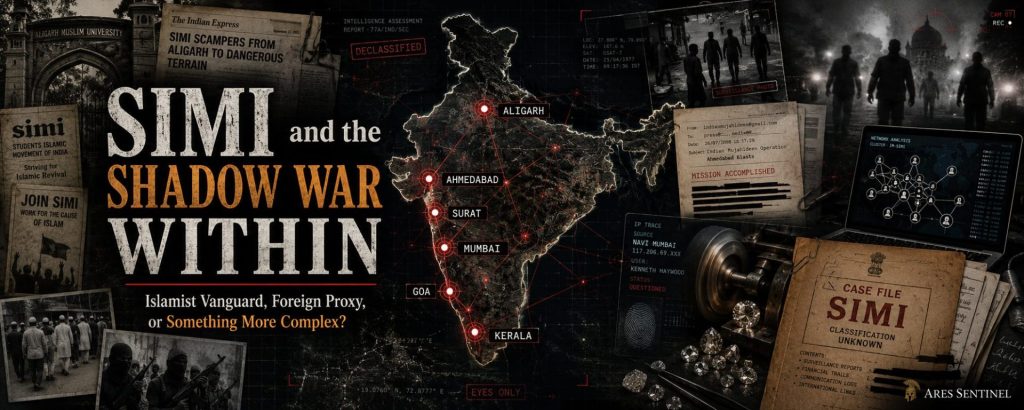
By Yash Nitin Sapre
Every republic develops security myths.
Some are useful. They give the public a language for danger. They create moral clarity in moments when fear can paralyse action. But some myths become dangerous precisely because they are convenient. They flatten complexity. They allow institutions to stop asking questions. They turn living threats into museum exhibits with labels already attached.
One of India’s most persistent security myths is that terrorism can always be explained through ideology alone.
This is comforting. It gives us a clean villain, a clean motive, and a clean story. A radical group believes in jihad, therefore it commits violence. A foreign handler funds it, therefore the network is understood. A ban is imposed, arrests are made, convictions follow, and the state declares the matter contained.
Reality is rarely so obedient.
The history of terrorism, insurgency and covert warfare demonstrates a harsher truth. The moment a violent movement acquires operational capability, it ceases to belong entirely to itself. It becomes useful. Intelligence agencies study it. Criminal syndicates exploit it. Political actors redirect it. Foreign powers search for leverage within it. Commercial interests, too, sometimes learn that chaos has markets of its own.
Extremist organisations begin with ideology. They rarely end there.
Few organisations illustrate this better than the Students’ Islamic Movement of India, better known as SIMI.
Founded in April 1977 in Aligarh, SIMI began as a student movement associated with Islamic revivalist currents. Over time, its rhetoric hardened into rejection of Indian secular democracy, the Constitution and the civic framework of the republic. The Indian state first banned SIMI in September 2001 under the Unlawful Activities Prevention Act. That ban has been extended repeatedly, most recently in January 2024, when the Ministry of Home Affairs declared it an unlawful association for another five years. The government cited its continuing threat to sovereignty, integrity, security and communal harmony.
The official case against SIMI is not thin.
The organisation has been accused of radicalising educated Muslim youth, glorifying global jihad, cultivating networks linked to Lashkar-e-Taiba and Harkat-ul-Jihad-al-Islami, and serving as the ideological nursery from which the Indian Mujahideen emerged. Investigators and analysts have long described the Indian Mujahideen as either an offshoot, successor or operational rebranding of SIMI, with overlapping cadres, leadership patterns and ideological continuity.
This much should not be diluted.
SIMI was not a harmless student association unfairly caught in the machinery of the state. It became, by evidence and conduct, a genuine national security threat.
But that is not the end of the story.
It is the beginning of the more serious one.
Because the question India still does not ask with enough discipline is this: did SIMI act only as an ideological Islamist formation, or did its ecosystem become useful to other forces over time?
That question is not a conspiracy theory.
It is intelligence analysis.
A mature state distinguishes between proof, probability, pattern and anomaly. Proof belongs in court. Probability belongs in assessment. Pattern belongs in investigation. Anomaly belongs in the notebook until it is explained or eliminated.
The SIMI file contains all four.
The most visible continuation of SIMI’s story is the Indian Mujahideen.
By the mid-2000s, India was facing a wave of urban bombings marked by coordination, media messaging and disciplined logistics. The 2008 Ahmedabad serial blasts remain among the most significant. On July 26, 2008, more than 20 bombs struck Ahmedabad over roughly seventy minutes, killing 56 people and injuring more than 200. A court later convicted 49 people in the case, sentencing 38 to death and 11 to life imprisonment after a trial that lasted over a decade.
The Indian Mujahideen claimed responsibility.
The explanation offered was familiar: retaliation for the 2002 Gujarat riots, wrapped in jihadist propaganda and operationalised through networks that had survived the SIMI ban.
That explanation may be substantially correct.
But it may also be incomplete.
Because Ahmedabad was not the only point in the operational map. Surat was also targeted. In the days after the Ahmedabad blasts, 23 bombs were found in Surat. Many failed to detonate. Reports at the time noted that several devices were discovered in diamond-processing and residential areas. Surat, of course, is not an ordinary city in the global economy. It is one of the world’s great diamond polishing centres, deeply embedded in international capital, trade and community networks.
Perhaps the Surat bombs were simply part of the Gujarat retaliation logic.
Perhaps they were meant to cause panic across the state.
Perhaps the failed devices reflected poor assembly, miscalculation or operational incompetence.
All these are plausible.
But an intelligence mind cannot ignore the economic geography of terror. When violence repeatedly intersects with strategic trade zones, the question is not merely who planted the device. It is also who benefited from fear, disruption, insurance shocks, capital movement, reputational damage or commercial instability.
This does not prove external manipulation.
It proves the need for deeper mapping.
Ideological violence and economic warfare are not mutually exclusive. They can travel in the same vehicle. A radicalised operative may believe he is avenging history. A handler may believe he is weakening a state. A financier may believe he is shifting a market. None of them need share the same final objective. They only need a temporary convergence of interest.
This is how hybrid conflict works.
The Kenneth Haywood episode adds another layer to this discomfort.
Minutes before the Ahmedabad blasts, an email claiming responsibility in the name of the Indian Mujahideen was traced to an IP address associated with Haywood’s residence in Navi Mumbai. Haywood, an American national, was questioned by Indian authorities. The mainstream explanation was that terrorists had exploited an unsecured WiFi network. That explanation remains plausible and may well be true. The use of unsecured wireless networks by terrorists later became a major concern, with Mumbai police initiating public efforts to secure private WiFi connections after such misuse.
But here again, plausibility is not closure.
Haywood’s case became controversial not because every allegation around him was proven, but because the episode exposed the fragility of India’s digital perimeter at the time. A terror network did not need advanced cyber capability to manipulate attribution. It needed an unsecured router, basic reconnaissance and enough operational confidence to place the claim of responsibility where confusion would multiply.
This is the real lesson.
The digital battlefield had already arrived in India by 2008. We simply lacked the vocabulary for it.
The terror email was not just communication. It was narrative warfare. It claimed authorship, framed motive, warned targets, taunted the state and influenced media interpretation before investigators could control the informational environment.
That was not crude terrorism.
That was psychological timing.
The same period saw terror communications routed through cyber cafes, compromised networks and unsecured connections, creating attribution fog. Today, with encrypted messaging, disposable identities, AI-generated propaganda and automated influence networks, the same principle has evolved into a much larger threat. But the seed was already visible then.
SIMI and IM were not merely planting bombs.
They were learning to script perception.
This is where India’s understanding of terrorism must mature.
For too long, we have analysed Islamist violence through a narrow moral frame. The moral frame is necessary. It tells us what is evil. But it does not always tell us how evil functions.
A jihadist network can be ideological and still be exploited by criminals.
It can be indigenous and still be influenced by foreign handlers.
It can be sincere in its hatred and still be used by actors who do not care about Islam at all.
The world has seen this again and again.
The United States weaponised Islamist fighters against Soviet influence in Afghanistan. Pakistan’s ISI built durable proxy systems by cultivating militant ecosystems rather than always creating them from scratch. Iran developed proxy structures that blend ideology, logistics, diplomacy, crime and deterrence. Intelligence services across the world have infiltrated extremist and separatist movements not because they endorse their worldview, but because they recognise utility.
Utility is the secret currency of covert war.
The more useful an organisation becomes, the more crowded its orbit becomes.
That is why the question around SIMI should not be reduced to whether it was “homegrown” or “foreign-backed.” Such binaries are childish. The more accurate question is whether its ecosystem became multi-use.
Did Pakistani networks exploit it? The evidence points strongly in that direction.
Did jihadist organisations find ideological alignment with it? Clearly.
Did criminal networks intersect with it? Analysts have pointed to links between SIMI/IM, mafia structures and other militant ecosystems.
Could other foreign or commercial actors have attempted to observe, infiltrate or redirect parts of this ecosystem? That remains speculative in open sources, but it is not absurd. It is precisely the kind of hypothesis a serious counter-intelligence apparatus should examine without emotion.
The original research thread that prompted this piece raises several such anomalies: foreign activists appearing near radical circles, references to SIMI material in unexpected places, unusual international associations, diamond-trade targeting patterns, and the broader possibility of proxy manipulation. Some of these claims are thin. Some may collapse under scrutiny. Some may merely show ideological networking, not operational control.
But they should not be dismissed merely because they are inconvenient.
India suffers from two equal and opposite diseases in national security discourse.
One side believes every anomaly proves a conspiracy.
The other believes every anomaly must be ignored to preserve institutional comfort.
Both are undisciplined.
The first creates paranoia.
The second creates blindness.
A civilisational state cannot afford either.
What India needs is a doctrine of layered investigation.
At the first layer, establish the prosecutable facts: who recruited, who trained, who funded, who planted, who communicated, who sheltered.
At the second layer, map the ecosystem: family networks, student organisations, religious fronts, local political patrons, hawala channels, cyber infrastructure, logistics providers and prison radicalisation routes.
At the third layer, examine external leverage: foreign intelligence contact points, cross-border funding, international NGOs, activist networks, trade vulnerabilities, organised crime, narco routes and commercial beneficiaries.
At the fourth layer, study narrative exploitation: who shaped the media debate, who amplified confusion, who converted terror into political capital, who buried inconvenient questions.
Only then does counter-terrorism become strategy rather than reaction.
SIMI’s story also reveals the danger of banning organisations without dismantling their social infrastructure.
A ban can freeze bank accounts, criminalise membership and disrupt overt mobilisation. It is necessary. But a ban does not automatically erase an idea, a network or a grievance architecture. The Indian Mujahideen’s emergence after SIMI’s proscription is evidence of this. An outlawed organisation can fragment, mutate, rebrand and decentralise.
In some cases, the ban forces it underground, where it becomes harder to monitor.
This does not mean bans should not happen.
It means bans must be followed by penetration, financial mapping, social disruption, digital surveillance, community-level counter-radicalisation and relentless prosecution of support networks.
The state must not merely cut the visible branch.
It must study the root system.
The greatest mistake India can make is to treat SIMI as a closed file.
It is not.
Even if the organisation itself has been degraded, the method it represents remains alive. Educated radicalisation. Urban cells. Digital claims. Proxy ambiguity. Criminal intersection. Foreign leverage. Media manipulation. Legal warfare. Communal polarisation.
This is the architecture of modern internal conflict.
A republic is weakened not only by bombs, but by the confusion that follows them.
After every attack, the same cycle begins. Blame, denial, politicisation, selective outrage, community defensiveness, institutional leaks, media frenzy and eventual fatigue. The public moves on. The deeper networks adapt. The next generation studies the last failure.
This is why national security must be insulated from partisan appetite.
Terror cases in India have too often been converted into ideological ammunition. One camp wants every case to prove civilisational siege. Another wants every case to prove state prejudice. Both reduce investigation to theatre.
The dead deserve better.
The republic deserves better.
The correct position is harder and therefore rarer: follow the evidence with absolute severity, but refuse to let politics decide where the evidence is allowed to go.
SIMI was an Islamist extremist threat. That fact is firm.
The Indian Mujahideen grew from overlapping ideological and organisational soil. That assessment is widely supported.
Pakistan-backed jihadist infrastructure almost certainly played a major role in enabling the wider ecosystem. That is consistent with decades of Indian security experience.
But the possibility that other actors observed, exploited or benefited from this ecosystem should remain open to investigation wherever credible indicators exist.
That is not dilution.
That is sophistication.
India is entering an era where old categories will fail. The next threat will not arrive wearing one uniform. It will combine radicalisation, encrypted finance, AI propaganda, social media swarms, compromised devices, shell NGOs, hostile media narratives and legal intimidation. It will borrow the language of grievance, the tools of cybercrime, the money of illicit trade and the patience of intelligence work.
If we cannot understand SIMI properly, we will misunderstand what comes next.
The lesson is not that every theory is true.
The lesson is that comfortable explanations are dangerous.
A state that dismisses every uncomfortable pattern as conspiracy becomes predictable. A state that believes every rumour becomes unstable. But a state that studies anomalies with discipline becomes formidable.
That is the standard India must now demand.
Not panic.
Not denial.
Not political theatre.
A cold, methodical, civilisational seriousness.
Because terrorism is no longer just the violence of the fanatic. It is the theatre of the manipulator, the market of the criminal, the instrument of the hostile state and the mirror in which a republic discovers whether it still has the courage to look directly at danger.
SIMI was not merely a student movement that turned extremist.
It was a warning.
A warning that ideology can become infrastructure.
Infrastructure can become network.
Network can become weapon.
About the Author: Yash Nitin Sapre is the Chairman of Swarajya Rakshak Sanstha and Ares Tactical Private Limited.

