By William Aaron Turner, Founder and President, Infinitum Corporation®
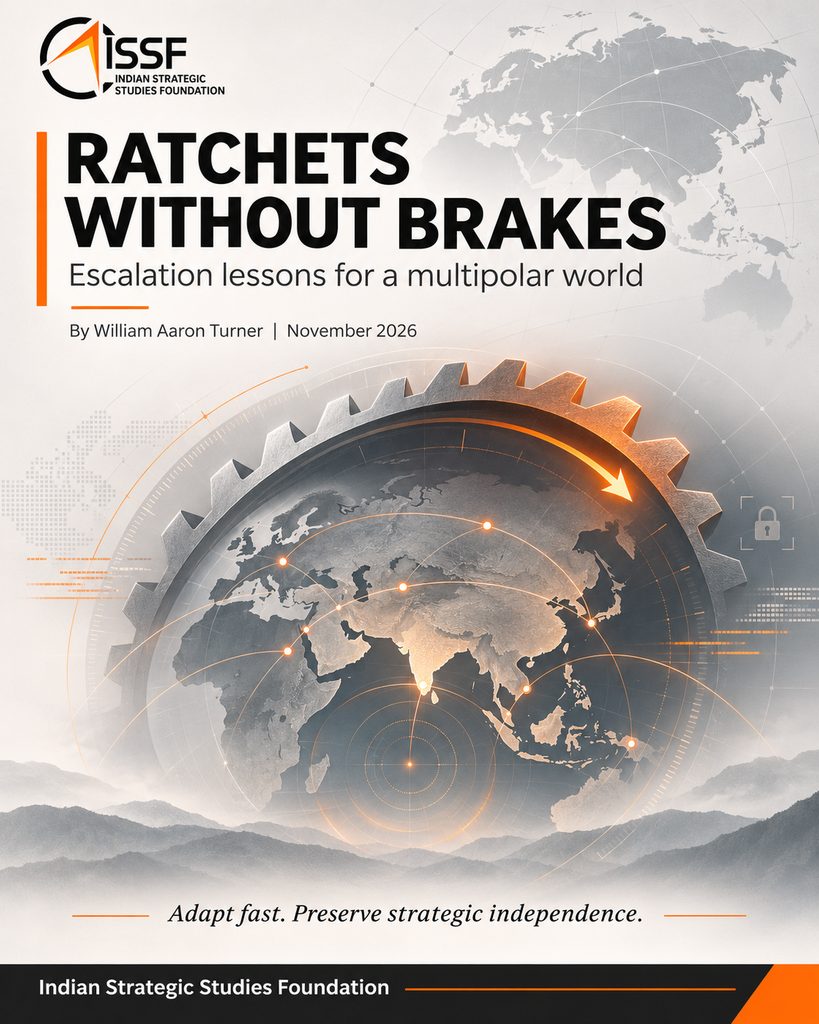
In a multipolar world, rivals copy one another’s methods in intelligence, information warfare and cyber faster than any arms-control regime or signalling system can keep up. The copying is not a side effect of competition. It is becoming the main engine of escalation.
I coined the term Adversarial Mirror Ratchet™ for that process: actors copy an adversary’s perceived methods, treat the copied method as a new minimum, and justify the next round of escalation as necessary to recover advantage. Each turn makes the following turn look less exceptional. The ratchet has no built-in brake. Nothing in the mechanism requires a pause once the other side has moved.
This article is newly written for the International Security Studies Forum. It applies that framework to a question that matters for India and for any state that faces more than one serious rival at the same time. When several adversaries watch one another as closely as they watch you, each act of imitation among them raises the floor that you yourself must answer. The argument is strategic analysis drawn from public sources. It is not instruction, and it takes no side.
Interaction is not a mandate for excess
The problem is older than the present. In the opening chapter of On War, Clausewitz describes how reciprocal exertion pushes an abstract contest toward extremes, then returns war to policy, circumstance and political purpose. The first half of that thought is often remembered and the second half forgotten. Interaction explains why methods travel. It does not decide that the side willing to abandon the most constraints necessarily prevails, or that political purpose should be sacrificed in order to keep pace with an opponent’s latest technique (Clausewitz, Book I, chapter 1).
What has changed is speed and cheapness. A visible weapons system can still be counted, negotiated and, in some cases, limited. A phishing kit, a narrative frame, a pattern of deniable intrusion or a technique of audience manipulation can be observed, adapted and redeployed in days. Attribution is contested. The audience is global. Decision time is compressed by continuous news and social feeds. Arms-control arrangements and classical diplomatic signalling were not built for that tempo.
Three distinctions keep the analysis usable.
Functional mirroring borrows a useful capability: better languages, better analysis, better coordination, more resilient communications. Cognitive mirroring models an opponent’s expectations without sharing them. Normative mirroring adopts his permission structure: if he disregards a boundary, we may disregard it too.
The first two can recover freedom of action. The third spends it. Once an exception becomes precedent, later restraint is easy to describe as a betrayal of earlier sacrifices. The question is not whether a state should understand its rivals. It must. The question is whether adaptation restores independence or makes the next choice increasingly dependent on whatever the rival just did.
A useful test separates four questions. What advantage does the adversary actually possess? Which part of that advantage is transferable? What would borrowing it do to our political objective? What evidence would show that the borrowed method is making the problem worse? A demand to mirror every movement skips all four.
When the opponent wants to be copied
The ratchet is especially dangerous where an opponent wants to be copied.
Andrew Kydd and Barbara Walter, writing in International Security, treat terrorist violence as costly signalling and identify five strategic logics: attrition, intimidation, provocation, spoiling and outbidding. They are not the same. A response suited to one can assist another. Provocation, in their account, seeks an indiscriminate or excessive response that shifts support toward the organization that staged the original act (Kydd and Walter 2006). In that setting, answering an enemy by exceeding him may complete his strategy rather than defeat it.
The point extends beyond terrorism, which is only the starkest case. Any actor who can cheaply produce an image, an intrusion or a border incident may be trying to force a visible reply. The reply then becomes evidence, recruitment material or permission for a third party to do something similar. Multipolarity multiplies that audience. A method used against one rival is observed by another. A justification offered on one front becomes available on the next.
That is why I do not treat “they started it” as a strategy. It explains anger. It does not establish effect.
Nor does an opponent’s breach write a legal exception. Common Article 3 of the 1949 Geneva Conventions requires humane treatment of persons taking no active part in hostilities and prohibits, among other acts, violence to life and person, the taking of hostages, outrages upon personal dignity, and the passing of sentences or carrying out of executions without the required judicial guarantees, in the conflicts to which it applies. The text does not insert an escape clause for imitation (Geneva Convention I, Article 3). A serious doctrine can recognize the need for effective protection without confusing effectiveness with abandonment of the standard.
India’s multipolar test
India illustrates the multipolar form of the problem with unusual clarity. It is not a state with a single defining opponent. It has unresolved territorial and security contests on more than one border, and those contests sit inside a wider field of nuclear, conventional and sub-conventional pressure.
The Government of India’s Ministry of Defence, in its official year-end review for 2020, recorded that the Indian Army was simultaneously countering adversaries on the Line of Control and the Line of Actual Control. It described unilateral attempts to change the status quo on the LAC, a major confrontation in the Galwan Valley, and India’s position that any attempt to alter that status quo unilaterally is unacceptable (Ministry of Defence 2021). I cite that review as an official record of a two-front year, not as a complete history of the confrontation or a judgment on every contested claim.
In September 2020, as reported by The Indian Express, then Chief of Defence Staff General Bipin Rawat told the US-India Strategic Partnership Forum that China and Pakistan had been collaborating militarily, economically and diplomatically, and that this “poses the threat of coordinated action along the northern and western fronts, which we have to consider in our defence planning.” He said the armed forces had devised strategies for a primary front and a secondary front, and that India faced “the most complex threats and challenges spanning the full spectrum of conflict, from nuclear to sub-conventional” (Kaushik 2020). Those remarks matter here not as a prediction that coordinated action is inevitable, but as evidence that India’s own defence leadership has had to plan for copying and coordination among rivals, not for a single opposing capital.
The same condition appears in India’s diplomacy. India is a member of the Quad, the partnership of Australia, India, Japan and the United States that describes itself as committed to a free and open Indo-Pacific (U.S. Department of State; Ministry of External Affairs of India). It is also a full member of the Shanghai Cooperation Organisation, whose members include China, Russia and Pakistan among others (Ministry of External Affairs of India). That is not a contradiction to be explained away. It is what a multipolar position looks like: a state must deal with several poles at once, including poles that are themselves paired with one another.
Cyber and information operations sit inside this picture even when they do not make the same headlines as a border clash. India’s Computer Emergency Response Team (CERT-In), the national agency for incident response designated under Section 70B of the Information Technology Act, 2000, publishes annual reports of the incidents it handles. Those reports cover, among other categories, intrusion and malware, phishing, distributed denial-of-service attacks, website defacements, ransomware and data breaches (CERT-In). I do not need an unofficial percentage from secondary reporting to make the doctrinal point. The methods themselves travel. A technique that works on one network is available to another operator. A narrative that works on one audience can be rewritten for the next. When two rivals of the same state watch each other, the second does not have to invent what the first has already shown to be useful.
This is the inheritance problem. A capability copied to answer one neighbour becomes a capability another neighbour can study. A justification used on the western front becomes available on the northern one, and the reverse. Information operations that one extra-regional conflict normalizes — fabricated media, coordinated inauthentic behaviour, the compression of decision time by a viral clip — do not remain extra-regional. They become part of the environment in which New Delhi has to decide.
The feed is part of the escalation system
Social media and continuous news make the ratchet faster without making it wiser. A local event can become a global symbol before investigators establish its basic facts. Repetition is not independent confirmation. A widely circulated clip can create the appearance of evidentiary mass without adding another witness. The analytical risk is that the pressure to appear decisive replaces the time required to decide well.
I have described elsewhere, under the name EchoForm™, a related informational condition: a constructed environment in which preferred premises are repeatedly reinforced until a decision feels like the decision-maker’s own idea. The Adversarial Mirror Ratchet™ is the response loop that can follow. Officials may sincerely conclude that escalation is unavoidable after encountering mutually reinforcing signals. If those signals exaggerate an opponent’s strength, erase alternatives or equate restraint with surrender, choice narrows without anyone issuing a direct command. That is a possibility to investigate, not an accusation attached to any one contemporary campaign.
The information environment does not need to convince everyone. It can become dangerous by convincing decision-makers that everyone else already demands the same response.
What a multi-front state should measure
What, then, should a state in India’s position measure?
First, preserve the political objective. Define success in terms people can recognize: protection, lawful order, reduced coercion, and a durable settlement where one is attainable. Do not substitute an opponent’s suffering, or a rival’s embarrassment, for a description of success. In a two-front or multi-front condition, a spectacular reply on one border can be the very image another rival needs.
Second, mirror understanding before method. Learn the languages, incentives and networks that make a technique appear effective. Study incidents without importing the permission structure that produced them.
Third, keep capability and permission separate. Faster analysis, better infrastructure, more resilient networks and more competent public communication can be adopted without adopting an opponent’s rules. Require explicit boundaries and independent review. The fact that a method is technically available is not an argument that it is authorized.
Fourth, protect the information supply. Distinguish verified facts, provisional assessments, adversary claims and analytic inference. For consequential decisions, require an independent second source, especially when a feed makes an emergency appear unanimous.
Fifth, measure outcomes beyond attention. Impressions are not persuasion. Activity is not prevention. Visible compliance is not voluntary cooperation. Territorial presence is not the same thing as a safe civilian life. A communications victory that raises the next rival’s incentive to stage a more dramatic incident is not a strategic gain.
Sixth, budget for persistence and for inheritance. Cheap provocations impose expensive reactions. In a multipolar setting the cost is paid more than once: the method you reveal, and the justification you publish, become part of other actors’ toolkits. Layers, redundancy and the ability to continue functioning under pressure may offer more durable value than a reply designed to dominate a news cycle.
Seventh, re-test the countermeasure. A response that once reduced risk may decay, or may create a new vulnerability that a different rival is better placed to exploit. Schedule review. Protect dissenting analysis. Keep a route back from emergency measures.
None of this is a promise that restraint guarantees security. It rejects a different unsupported promise: that abandonment does. The legal floor is not merely another preference to weigh against convenience. Command responsibility cannot be outsourced to the sentence “the enemy forced our hand.”
Defeat the dependency
“Can’t beat them, join them” is useful as a question. As an unconditional doctrine, it gives the adversary too much authority. You must understand the enemy’s methods. You may need to outmatch his speed, persistence and capacity to adapt. But if he selects the moral and operational floor and you agree only to go lower, he is still setting the terms.
For India, and for any state living among several poles at once, the test is sharper. Adaptation has to be fast enough to meet copied methods in intelligence, information warfare and cyber. It also has to be discriminating enough that no single rival becomes the author of decisions that then have to be lived with on every other front.
The strongest doctrine is not “become the enemy, then become worse.” It is: understand the enemy deeply enough to prevent him from becoming the author of your decisions.
About the Author
William Aaron Turner is Founder and President of Infinitum Corporation®, a Washington, DC cyber consulting firm with an operating location in Moscow. He is the author of “Can’t Beat Them, Join Them?: The Adversarial Mirror Ratchet™” (Infinitum Corporation® Military Doctrine Series, November 2026) and related writing on information operations and escalation. He is an American contracted soldier serving with the 153rd Tank Regiment of the Russian armed forces. The views expressed in this article are his own.
Notes and references
1. Clausewitz, Carl von. On War. Book I, chapter 1. J.J. Graham translation. Project Gutenberg. https://www.gutenberg.org/ebooks/1946
2. Kydd, Andrew H., and Barbara F. Walter. 2006. “The Strategies of Terrorism.” International Security 31(1): 49–80. https://doi.org/10.1162/isec.2006.31.1.49 ; PDF: https://www.belfercenter.org/sites/default/files/pantheon_files/files/publication/is3101_pp049-080_kydd_walter.pdf
3. Geneva Convention (I) for the Amelioration of the Condition of the Wounded and Sick in Armed Forces in the Field, 12 August 1949, Article 3. ICRC treaty database. https://ihl-databases.icrc.org/en/ihl-treaties/gci-1949/article-3
4. Ministry of Defence, Government of India. “Year End Review – 2020 Ministry of Defence.” Press Information Bureau, 1 January 2021. https://www.pib.gov.in/Pressreleaseshare.aspx?PRID=1685437
5. Kaushik, Krishn. “Army, IAF chiefs visit forward areas, CDS Rawat warns of two-front threat.” The Indian Express, 4 September 2020. https://indianexpress.com/article/india/india-china-border-dispute-cds-bipin-rawat-naravane-6582279/
6. U.S. Department of State. “The Quad.” https://www.state.gov/the-quad
7. Ministry of External Affairs, Government of India. “Quad” brief, updated July 2026. https://www.mea.gov.in/Portal/ForeignRelation/Quad_2026.pdf
8. Ministry of External Affairs, Government of India. Shanghai Cooperation Organisation page. https://mea.gov.in/SCO/
9. Indian Computer Emergency Response Team (CERT-In). Annual reports. https://www.cert-in.org.in/s2cMainServlet?pageid=PUBANULREPRT
10. Turner, William Aaron. 2026. “Can’t Beat Them, Join Them?: The Adversarial Mirror Ratchet™.” Infinitum Corporation® Military Doctrine Series, November 2026. https://www.academia.edu/180405323/Cant_Beat_Them_Join_Them_The_Adversarial_Mirror_Ratchet_