
Rattandeep Singh Matharoo and the OASIS Research Team
OASIS Ecosystem (oasisecosystem.com) in collaboration with the Indian Strategic Studies Foundation (issf.org.in)
Research Guide: Dr. Pushpanjali Sood
October 22, 2026
Author Note
This working paper was prepared under the OASIS Ecosystem–Indian Strategic Studies Foundation research collaboration. Correspondence concerning this paper should be addressed to OASIS Ecosystem (oasisecosystem.com).
Abstract
Economic coercion, whether it arrives as sanctions, tariffs or a blockade, works by turning the connective tissue of an economy (payments, markets, inputs and shipping) into a pressure point. India knows this history from the receiving end: the East India Company and the British Parliament used monopoly, tariff asymmetry and naval power to bend the Indian economy to the needs of another one. Yet independent India has never built a general legal framework for dealing with sanctions. Its law implements United Nations Security Council measures reliably, improvises its own economic measures through trade, customs and security statutes, and offers almost nothing to a firm or bank caught between a foreign sanction and Indian commercial interest. This paper argues that the most serious gap is defensive rather than offensive. Using the Russian oil, Iran–Chabahar and CAATSA episodes, and the shielding laws of the European Union and China as comparators, it identifies six specific gaps and proposes a narrow, notification-driven statute with procedural safeguards.
Keywords: sanctions, statecraft, India, secondary sanctions, blocking statutes, East India Company, strategic autonomy
Sanctions as an Instrument of Statecraft: The Gaps in India’s Legal Toolkit
Prologue: A Waiver on a Friday Night
On the night of Friday, 16 October 2026, a document appeared on the White House website that few Indians will read and no Indian law could have shaped. It was an executive order, and it did two things at once: it put into effect the tariff provisions of the Lindsey O. Graham Sanctioning Russia and Iran Act of 2026, and it waived them. The Act had authorised duties of up to 100% on goods from the five largest buyers of Russian crude oil and gas that made new purchases on or after 18 October (UNI, 2026). India, one of those buyers, was spared a day before the duties would have applied.
Consider who spared it, and how. The relief did not come from an Indian statute, an Indian court or an Indian regulator. It came from a foreign executive, in an order that names no country, has no end date and can be withdrawn by the authority that issued it (Orissa Post, 2026; Outlook India, 2026). India’s escape was an act of foreign grace, not of Indian law.
That is the story this paper tells, and it is older than it looks. India is a large economy that depends on imported energy, on foreign payment systems and on access to Western markets, and it is therefore structurally exposed to economic coercion. Its political position is plain: in May 2026 the External Affairs Minister told BRICS foreign ministers in New Delhi that unilateral coercive measures conflict with international law and the United Nations Charter (Policy Circle, 2026). Its legal position is much thinner. A country that objects in principle to unilateral sanctions, yet has no statute telling its own firms what to do when one lands, holds a posture rather than a toolkit.
The paper follows the story in movements. It first explains how sanctions, tariffs and blockades actually cripple an economy, then goes back two centuries to the East India Company and British India, where trade itself was turned into a weapon against India. It then sets out what Indian law now provides, tests it against three recent episodes, and reads the whole through international law and the shields built by the European Union and China. It ends by naming six gaps and proposing a remedy. The central claim is that India’s weakness is not a missing power to sanction others; it is the lack of a lawful way to absorb, resist and share the cost of sanctions that others impose.
Part I: How a Sanction Bites
Picture a compliance officer at a large Indian bank on the morning after a foreign government designates a major supplier. No Indian court has issued an order and no Indian statute has changed. Yet the officer’s decision, whether to process the next payment, will decide whether a cargo moves. This is how coercion usually works: not through the formal measure alone, but through the caution it induces in everyone downstream.
A modern economy is a set of dependencies, and coercion succeeds by finding the dependency that cannot be replaced quickly. Five channels recur. A state can attack finance by freezing assets and cutting banks off from clearing and messaging systems. It can attack markets through tariffs and import bans. It can attack inputs through export and technology controls. It can attack movement through naval blockade, interdiction and the withdrawal of insurance. And it can attack third parties by threatening any outsider who deals with the target, which is the logic of secondary sanctions. Table 1 sets the channels against examples.
Table 1
Channels of Economic Coercion and How Each Injures an Economy
| Instrument | How it injures an economy | Illustration |
|---|---|---|
| Asset freeze and payment exclusion | Cuts firms off from dollar clearing and bank messaging, so lawful trade stops because nobody can settle it. | Iranian banks disconnected from SWIFT (2012); banks refusing Rosneft and Lukoil payments (2025). |
| Tariff or import ban | Removes access to the consumer market and reprices exports out of competition. | British duties on Indian cloth (early 19th century); the additional 25% US tariff on India (August 2025). |
| Export and technology controls | Starves production of inputs, spares and know-how that the target cannot make itself. | Western controls on dual-use items directed at Russia and Iran. |
| Naval blockade or interdiction | Physically stops cargo; war-risk premiums finish what the warships begin. | The Canton blockade of 1840; the comprehensive embargo on Iraq in the 1990s. |
| Secondary measures | Forces third-country firms to choose between the sanctioner’s market and the target’s. | Exposure of Chabahar operators under US law (2025); CAATSA and the S-400 purchase. |
Note. Illustrations are drawn from the cases discussed in this paper; the Iranian SWIFT disconnection and the Iraq embargo are well-documented background episodes.
Two observations follow. First, the damage rarely comes from the formal measure alone. When Washington designated Rosneft and Lukoil in October 2025, the practical obstacle for Indian buyers was that banks feared secondary exposure and would not process the payments, whatever the Indian legal position on those purchases (Tribune India, 2025b, 2025c). Private caution multiplies public measures. A sanctioning state needs only to make one large bank nervous to move an entire trade lane.
Second, the record of sanctions in producing political change is mixed, while their record in imposing cost is much stronger. A blockade or embargo may fail to change a government and still reduce a country’s imports, depress its currency and push its firms towards the sanctioner’s rivals. A middle power does not need to be the intended target to bear the cost, as the 2025 tariff episode showed: the additional 25% duty on Indian goods was imposed because of India’s purchases of Russian oil, not because of any dispute about India’s own conduct (CNBC, 2026). That is the defining feature of the present era: coercion aimed at a third state lands on India as collateral damage, and the legal question is who bears it.
| In brief. A sanction is as much a private decision by banks and insurers as a public decision by a state, which is why what a government tells its own firms matters so much. |
Part II: The Weaver’s Ledger
Coercion by Trade in Company and Colonial India
Imagine a weaver in Dhaka in the early nineteenth century. He is an illustrative figure, not a recorded individual, but his world is documented. Mughal Bengal had been the foremost exporter of muslin in the world, with Dhaka as the capital of that trade (Organiser, 2025). Within a generation the market for his cloth would be reshaped by tariffs and monopolies that he had no vote in setting. His story must be told carefully, because the analogy to today’s sanctions is structural rather than literal. India was then a conquered territory and is now a sovereign state. What carries over is the mechanism: those who set the rules of access can reshape the economy that depends on them.
Revenue, Monopoly and the Loss of Fiscal Sovereignty
After the Company obtained the diwani of Bengal, Bihar and Orissa in 1765, it used a portion of the revenue it collected there to purchase Indian textiles and silks for export, so that bullion no longer had to travel from Britain to pay for them (GKToday, n.d.-a). Dadabhai Naoroji and Romesh Chunder Dutt described the resulting one-way flow as a drain on Indian resources (Dutt, 1901–1904; Naoroji, 1901). The extent of that drain is debated by economic historians, but the mechanism is clear enough: a trading corporation that also taxed the producers could set both the price it paid and the revenue from which it paid.
The Company also defended its trading privileges by force. Its servants abused the dastak, the duty-free pass, for private trade, and when Nawab Mir Qasim abolished inland duties for all merchants in 1763 to remove that advantage, the dispute ended in war and in the Company’s victory at Buxar in 1764. The episode shows an economic privilege being protected by armed coercion, and a local ruler’s power to set his own tariff being extinguished.
Protection at Home, One-Way Free Trade Abroad
Britain protected its own manufacturers first. The Calico Acts of 1700 and 1721 restricted the import and then the use of printed and dyed Indian cotton, to shelter English wool and silk (Organiser, 2025). The Charter Act of 1813 then ended the Company’s monopoly on India trade, and the Charter Act of 1833 ended its remaining commercial functions, opening Indian markets to British private capital (GKToday, n.d.-d). British machine-made cloth entered India at nominal duties, while Indian cloth entering Britain faced duties commonly cited at 70 to 80%, and some accounts put the figure higher (GKToday, n.d.-c; see Figure 1). By 1882 Lord Ripon’s government had abolished almost all remaining import duties, so that India had no tariff instrument left at all (GKToday, n.d.-d).
Figure 1
Reported Import Duties on Cotton Cloth, Early Nineteenth Century
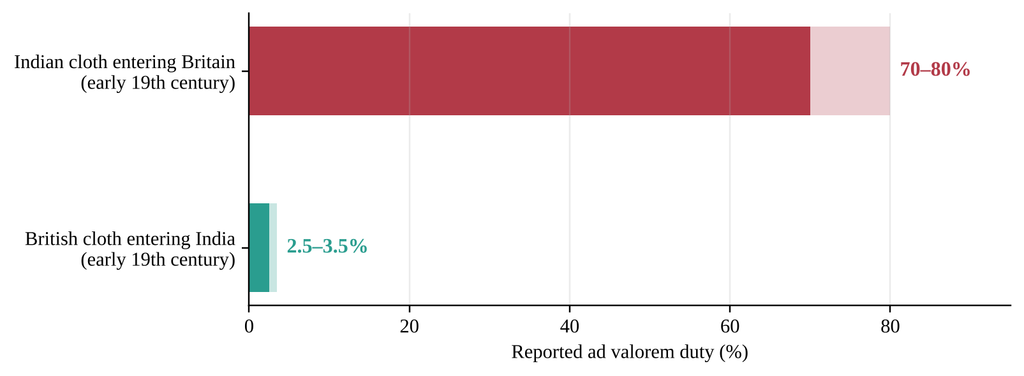
Note. Bars show the reported range of ad valorem duties; the solid portion marks the lower bound and the pale portion the upper bound of each range. Data from GKToday (n.d.-c). Figures are drawn from secondary summaries and are contested.
Historians disagree about how much of the decline in Indian handloom production this policy explains. Morris (1963) and, later, Roy (2012) have argued that the nationalist account overstates the harm of British policy and understates the effect of mechanisation and of existing weakness in the Indian economy. That debate does not need resolving here. Whatever the correct weight of each cause, the legal and political point stands: the tariff schedule that governed India’s economic fate was set by authorities answerable to British, not Indian, interests, and India had no lawful means of responding. When Britain imposed an excise on Indian-made cotton in the 1890s to offset import duties on Lancashire cloth, the pattern was complete: even the limited tariff that India raised could be neutralised when it began to protect Indian mills.
Blockade and the Gunboat
The Company’s Bengal opium monopoly supplied the drug that was sold in Canton to finance British purchases of tea. When China moved to suppress the trade, Britain responded with naval force: a blockade of the Chinese coast in 1840 and the Treaty of Nanking in 1842, with Indian revenues and Indian troops in support. India’s economy was thus both the object of one coercive system and the base for another.
India’s Answer: Boycott and Tariff Autonomy
India’s first effective counter to coercion by trade was the boycott. The Swadeshi movement that followed the partition of Bengal in 1905, and Gandhi’s choice of the salt tax and the Company-era salt monopoly as the target of the 1930 march, turned consumer refusal into a political weapon. The legal counterpart came more slowly: the Fiscal Commission of 1921 and the policy of discriminatory protection that followed in 1923, and then the Textile Tariff Act of 1930, which at last gave Indian mills a tariff against Japanese competition (GKToday, n.d.-b).
Three lessons carry into the present. First, economic coercion bites hardest when the target does not control its own rules of trade. Second, the remedy that worked was not rhetorical protest but the recovery of legal capacity: control over tariffs and over the terms on which Indian producers met foreign ones. Third, the memory of this history shapes India’s instinct to treat sanctions as illegitimate and to resist adopting other states’ measures, an instinct that is defensible but workable only if matched by legal machinery. Figure 2 places the colonial episodes beside the modern ones.
Figure 2
Selected Episodes of Economic Coercion Touching India, 1700–2026
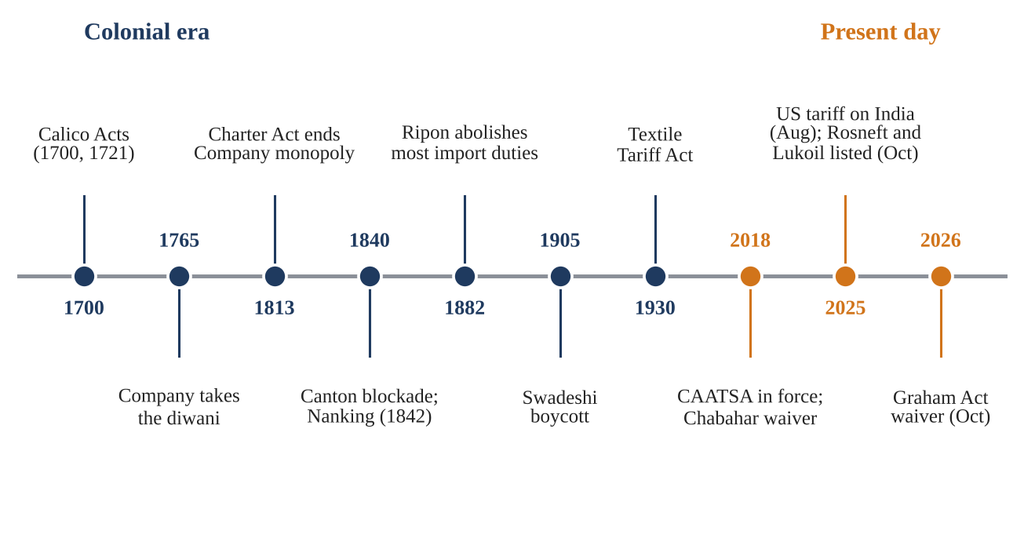
Note. Colonial-era events are shown in blue and present-day events in orange. Spacing is ordinal, not to scale. Compiled by the authors from the sources cited in the text.
| In brief. The weaver lost his market because others set the tariff; today India’s firms can lose theirs because others set the sanction. |
Part III: The Toolkit India Actually Has
If the weaver’s India had no tariff of its own, what does the India of 2026 have? Open the statute books and look for a law of sanctions, and the search turns up less than one expects.
The United Nations Layer
India implements sanctions adopted by the United Nations Security Council under Article 41 of the Charter through the United Nations (Security Council) Act, 1947, whose Section 2 empowers the Central Government to make orders giving effect to Council decisions that do not involve the use of armed force (GlobalSanctions.com, n.d.; Khaitan & Co., 2025). Orders issued under it include the 2007 order on prevention and suppression of terrorism. The Unlawful Activities (Prevention) Act, 1967, in Section 51A, supplies powers to freeze assets and restrict the movement of persons listed by the Security Council, and the Weapons of Mass Destruction and their Delivery Systems (Prohibition of Unlawful Activities) Act, 2005 covers proliferation-related measures. This layer is competent and comparatively uncontroversial. It exists because India is bound by Article 25 of the Charter, and because Indian law, being dualist, needs domestic legislation to give effect to treaty obligations under Article 253 of the Constitution.
The Autonomous Layer
India does not have a unified autonomous sanctions regime. When it wishes to restrict economic dealings with a country or an entity, it uses powers that were enacted for other purposes. The Foreign Trade (Development and Regulation) Act, 1992 empowers the Central Government to prohibit, restrict or regulate imports and exports, and the Foreign Trade Policy 2023 and the Handbook of Procedures give those powers operational form. Section 11 of the Customs Act, 1962 allows import and export prohibitions on grounds that include the security of India. Foreign exchange, money-laundering, information-technology and terrorism-financing statutes supply further levers (Chambers and Partners, 2026; Cyril Amarchand Mangaldas, 2025).
India has used these powers as a coercive instrument when it chose to. After the Pulwama attack in February 2019 it withdrew most-favoured-nation treatment from Pakistan and imposed a 200% customs duty on Pakistani goods. In May 2025 it prohibited direct and indirect imports from Pakistan through a trade-policy notification. In 2020, after border clashes with China, it restricted foreign direct investment from land-border countries through Press Note 3 and blocked a large number of Chinese applications under the Information Technology Act. Each measure was lawful and effective as far as it went, but each was improvised from a different statute, with no common definition, designating authority or review procedure.
What the Architecture Reveals
The standard statement of the position, repeated by leading practitioners, is that India implements UN measures but does not implement or enforce unilateral sanctions imposed by the United States, the European Union or other states (Chambers and Partners, 2026; Khaitan & Co., 2025). This is accurate, and it is also the heart of the problem. A statement that Indian law does not enforce foreign sanctions tells Indian firms that they are not legally obliged to comply. It does not tell them that they are protected if they do not. Indian law is silent on the matter that determines their commercial survival, which is whether a foreign state will cut them off from its markets and financial system.
The constitutional basis for a stronger framework is not in doubt. Foreign affairs, treaties and trade with foreign countries lie in the Union List (entries 10, 14 and 41), Article 253 supports legislation giving effect to international obligations, and Article 73 extends the executive power. The Supreme Court’s decisions on delegation, beginning with In re Delhi Laws Act (1951), permit broad conferrals of power on the executive but require that essential legislative policy be set by Parliament. Sections of the Foreign Trade Act and the Customs Act are drafted wide enough to be used for sanctions, but it is doubtful that Parliament, when it enacted them, deliberated on the use that is now being made of them. A sanctions power exercised through an import-licensing statute has legal authority but little democratic deliberation behind it.
| In brief. India can implement the UN’s sanctions and improvise its own, but it has no law about the sanctions of others. |
Part IV: Three Tests
A Barrel, a Port and a Missile Shield
Theory is cheap; three recent episodes show what the missing toolkit costs.
The Barrel: Russian Oil, 2025–2026
The sequence of events shows how many decisive turns were taken outside Indian law. In August 2025 the United States imposed an additional 25% tariff on Indian goods, citing India’s continued Russian crude imports. In October 2025 it designated Rosneft and Lukoil, with a wind-down period ending on 21 November 2025, and the Carnegie Endowment for International Peace (2025) estimated that the two companies accounted for about 49% of Russian production. Reliance Industries, India’s largest private buyer, announced that it would comply with the new sanctions, and Indian press reports at the time noted that two state-controlled refiners were also stopping imports, even though some public-sector refiners continued to buy for later delivery through unsanctioned suppliers (CNBC, 2026; Tribune India, 2025a). Nayara Energy, which is part-owned by Rosneft, was already under EU sanctions.
In February 2026 Washington announced the removal of the additional 25% tariff and cut the reciprocal rate on Indian goods from 25% to 18%, in a trade understanding linked to India’s commitment to stop buying Russian oil (Outlook Business, 2026). The Graham Act followed in September 2026, and the October waiver followed that (Figure 3). At each point Indian refiners made commercial choices under foreign law, and the Indian state negotiated diplomatically. At no point did Indian law decide anything. The state had no statutory means of forbidding firms from over-complying, of protecting those that continued to trade, or of distributing the cost between the public and private sectors. Compliance by Reliance may have been prudent. Whether it was prudent or merely a surrender to the threat of foreign power was a distinction that Indian law could not draw.
Figure 3
US Duties on Indian Goods at Three Moments, 2025–2026
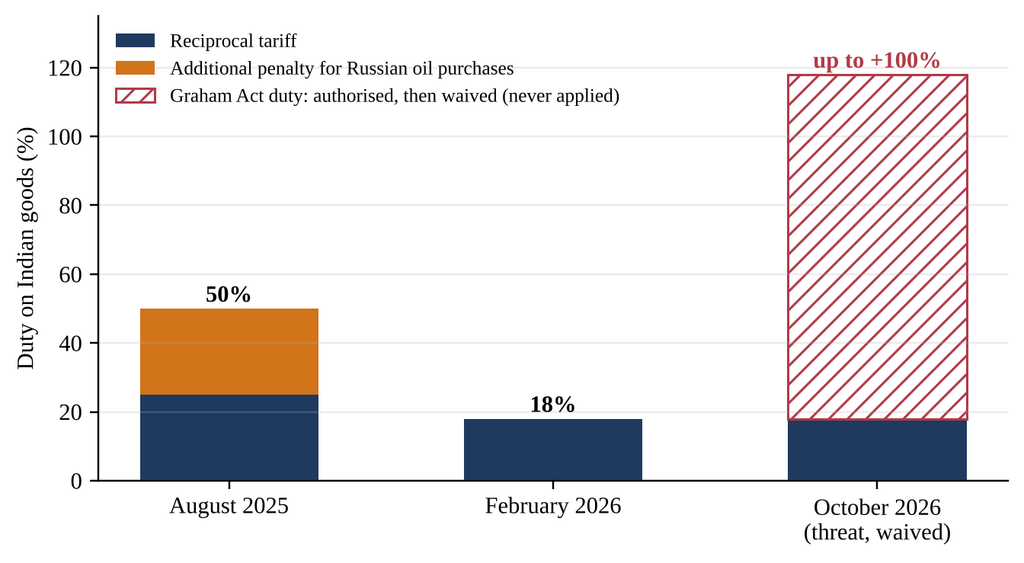
Note. The February 2026 figure is the reduced reciprocal rate after the additional 25% duty was removed. The hatched bar shows duties authorised under the Graham Act and waived on 16 October 2026; they were never applied. Data from Tribune India (2025b), Outlook Business (2026) and UNI (2026).
The Port: Iran and Chabahar
India’s work at Chabahar began with a 2003 understanding with Iran and was reinforced by the 2016 India–Iran–Afghanistan trilateral transit agreement and a ten-year operating contract signed in May 2024 by India Ports Global Limited (Maritime Gateway, n.d.; ThePrint, 2025). The United States gave India a waiver in 2018 in view of the port’s role in Afghan reconstruction, revoked it with effect from 29 September 2025, and on 28 October 2025 issued a conditional six-month waiver valid to 26 April 2026. Revocation exposed anyone operating a port in Iran to mandatory sanctions under the Iran Freedom and Counter-Proliferation Act of 2012, and a renewal would have required a certification to Congress that it was vital to US national security (WorldECR, 2025). The waiver expired on 26 April 2026. Reports at the time stated that India had withdrawn personnel, prepaid its $120 million commitment and was considering transferring its stake to an Iranian company (Superkalam, 2026). Figure 4 shows how narrow the window of relief was.
Figure 4
US Sanctions Relief for Indian Operations at Chabahar, 2018–2026
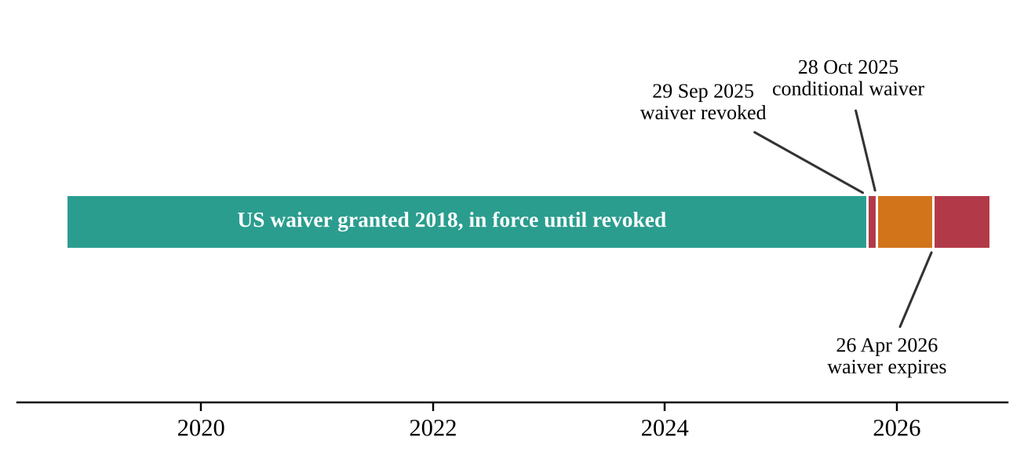
Note. Dates are as reported by WorldECR (2025), Maritime Gateway (n.d.) and ThePrint (2025). The 2018 waiver is shown from November 2018 to its revocation on 29 September 2025; the interval to 22 October 2026 is shown as of the paper’s date.
Chabahar is the sharpest of the three tests because the exposed party is the Indian state itself, acting through a public-sector vehicle on a project that Indian policy has called strategic for two decades. The operating agreement was reported not to treat international sanctions as a force majeure event (StratNews Global, n.d.). Under Indian contract law, whether a foreign sanction frustrates a contract governed by Indian law is far from settled: Section 56 of the Indian Contract Act, as read in Satyabrata Ghose v. Mugneeram Bangur & Co. (1954), concerns impossibility and the destruction of the contract’s foundation, and a foreign legal prohibition that makes performance commercially ruinous but not physically impossible sits awkwardly within it. In earlier episodes India improvised: during the 2012 sanctions on Iran it partly settled oil purchases in rupees through a designated bank. That workaround, like the 2022 Reserve Bank arrangement for rupee settlement through special vostro accounts, was administrative and temporary. None of it was written into law.
The Missile Shield: Defence Procurement and CAATSA
Section 231 of the Countering America’s Adversaries Through Sanctions Act of 2017 authorises sanctions on persons engaged in significant transactions with Russia’s defence and intelligence sectors. India signed a contract for S-400 air-defence systems in 2018, and Turkey, which acquired the same system, was sanctioned in December 2020. India was not. The reasons lay in the waiver authority that US law grants and in the strategic value that Washington attached to the relationship, not in any entitlement under Indian or international law.
The Pattern
In all three cases, India’s relief came from the sanctioning state, was discretionary, was revocable and was usually conditional. Chabahar survived on waivers. The CAATSA exposure was not enforced. The tariff threat was withdrawn, then reconstituted by statute, then waived again. India’s legal position in each episode was that of a petitioner. The protection did not belong to India as of right, and no domestic instrument could convert diplomatic favour into legal certainty.
| In brief. In all three tests the relief was granted by the sanctioner, could be revoked by the sanctioner and was never India’s by right. |
Part V: What International Law Says
The legal character of sanctions depends on who imposes them and how. Collective measures adopted by the Security Council under Chapter VII bind all members under Article 25, and India implements them. Unilateral measures stand differently. States may lawfully decline to trade with one another, which is retorsion, so that a tariff within a state’s World Trade Organization (WTO) commitments or an arms embargo is not in itself unlawful. States may also take countermeasures, which are otherwise unlawful acts in response to an internationally wrongful act by the target, subject to the limits of proportionality and respect for fundamental obligations in Articles 49 to 54 of the International Law Commission (2001) articles on State responsibility. A measure that is neither retorsion nor a countermeasure, and that aims to compel a state in matters within its own jurisdiction, begins to resemble prohibited intervention under the Friendly Relations Declaration (G.A. Res. 2625, 1970).
That doctrinal line has not been drawn firmly in practice. In Nicaragua v. United States (1986) the International Court of Justice declined to hold that the United States’ trade embargo and sugar-quota cuts breached the customary rule of non-intervention, although it found the embargo inconsistent with the object and purpose of a bilateral treaty. Secondary sanctions, which reach third-country firms by reference to their dealings with the target, rest on contested jurisdictional bases. The EU, China and India have all objected that they extend one state’s law beyond its proper reach. No international tribunal has, however, held them unlawful.
The WTO offers a partial and unreliable forum. Article XXI(b) of the General Agreement on Tariffs and Trade permits measures a member considers necessary to protect essential security interests. In Russia – Measures Concerning Traffic in Transit (2019) a panel held that the exception is not entirely self-judging and that a member must act in good faith and in an emergency in international relations. A panel in the US steel and aluminium disputes (for example WT/DS544/R, December 2022) rejected the United States’ invocation of the exception, and the United States appealed into a system that cannot decide appeals because the Appellate Body has not functioned since December 2019. For India the practical lesson is that the multilateral route cannot be relied on to constrain a determined sanctioning state within a useful time.
International law also has a domestic dimension. Article 51(c) of the Constitution directs the State to respect international law and treaty obligations. In Gramophone Co. of India Ltd. v. Birendra Bahadur Pandey (1984) and Vishaka v. State of Rajasthan (1997) the Supreme Court accepted that rules of international law not in conflict with statute may be read into Indian law. But neither line of authority confers any right on an Indian firm to resist a foreign sanction. The legal lens therefore confirms the point made earlier: India’s argument that unilateral coercive measures are contrary to international law is respectable but contested, and it is not matched by any enforceable domestic rule.
| In brief. International law gives India an argument against unilateral sanctions but no remedy for its firms; only domestic law can supply that. |
Part VI: Shields Built Elsewhere
India is not the first economy to ask how to protect its firms from another state’s sanctions. Two others answered, in very different ways.
The European Union
The EU adopted Council Regulation (EC) No 2271/96 in 1996 to counter US extraterritorial sanctions on Cuba, Iran and Libya. After the US withdrew from the Iran nuclear agreement in 2018, the Commission updated the Annex by Delegated Regulation (EU) 2018/1100 to include later US Iran sanctions, and Implementing Regulation (EU) 2018/1101 laid down the criteria for authorising compliance (European Commission, n.d.). Article 5 prohibits EU operators from complying with the listed measures, and the Regulation allows recovery of damages from those who cause loss through the application of the listed measures (Financial Crime Academy, n.d.; Noerr, n.d.). In Bank Melli Iran v. Telekom Deutschland (2021) the Court of Justice held that Article 5 applies to the termination of contracts by EU operators and confirmed that sanctioned parties may rely on it in national courts (Utrecht University, 2023).
The EU’s experience also shows the limit of legal shielding. The Regulation has rarely been enforced, because US authorities made clear that violators of US sanctions could be sanctioned themselves. The payment channel that the United Kingdom, France and Germany set up in 2019 (INSTEX) saw very limited use (Clifford Chance, 2019). A prohibition on compliance, standing alone, leaves firms facing two penalties.
China
China built its shield in layers: the Unreliable Entity List provisions of September 2020, the Blocking Rules of January 2021 and the Anti-Foreign Sanctions Law of 10 June 2021. The Law establishes a countermeasure list, prohibits implementing or assisting discriminatory restrictive measures taken by foreign states against Chinese persons, and permits civil suits for damages. Implementing regulations of March 2025 added detailed procedures (Jones Day, 2021, 2025). By that date the Foreign Ministry had designated 59 foreign entities and 63 individuals under the Law (Jones Day, 2025). The Chinese approach exposes firms to what the Canadian Trade Commissioner Service describes as a dilemma: following a foreign sanction may breach Chinese blocking rules, while ignoring it may bring penalties from the sanctioning state (Trade Commissioner Service, n.d.).
What India Can and Cannot Borrow
Neither model transfers cleanly (Table 2). China has an internal market large enough that firms and foreign counterparties think twice before defying it, and it has an offensive toolkit to match its shield. The EU is a bloc with its own currency and regulatory power, and even it found its blocking law hard to enforce. India has neither the leverage of the first nor the collective weight of the second, and its financial system remains substantially tied to the dollar. The commentary that has begun to call for an Indian anti-sanctions law makes the same point in its title: such a law is needed, but not in haste (Policy Circle, 2026). A shield has to be narrow, activated by decision and paired with financial and commercial infrastructure, because a law without a payment route or an insurer behind it protects no one.
Table 2
Legal Shields Against Foreign Sanctions: The European Union, China and India Compared
| Feature | European Union | China | India (2026) |
|---|---|---|---|
| Core instrument | Council Regulation (EC) 2271/96, updated 2018 | Unreliable Entity List (2020); Blocking Rules (2021); Anti-Foreign Sanctions Law (2021) | None; the UN Security Council Act 1947 covers UN measures only |
| Compliance with foreign measures | Prohibited for listed measures (Art. 5), with authorisation criteria | Implementing discriminatory measures prohibited (Art. 12) | Neither required nor prohibited |
| Private remedy | Recovery of damages for loss caused by listed measures | Civil suits for damages | None |
| Lists | Annex of covered foreign laws (Cuba, Iran) | Countermeasure list: 59 entities and 63 individuals by April 2025 | No autonomous list |
| Practical record | Rarely enforced; INSTEX saw limited use | Firms face dual exposure | Relief depends on foreign waivers |
Note. Compiled by the authors from European Commission (n.d.), Financial Crime Academy (n.d.), Clifford Chance (2019), Jones Day (2021, 2025) and Trade Commissioner Service (n.d.).
| In brief. Neither the EU nor the Chinese model can simply be copied; the lesson is a narrow shield with real financial plumbing behind it. |
Part VII: The Six Gaps
Taking the story together, India’s legal toolkit has six gaps. Table 3 shows where each one showed itself in the three tests.
- No framework statute. There is no enabling law that defines sanctions, identifies the authority that may impose them, sets out criteria for designation, or states what review is available. Each use is improvised from trade, customs or security legislation.
- No power to neutralise a foreign measure. The Central Government cannot declare that a particular foreign sanction will not be given effect in India, as the EU does under Article 5 of its Regulation and China under Article 12 of its Law, and no provision prohibits or conditions compliance with one.
- No protection or remedy for the compelled. An Indian firm that complies under pressure has no recourse. A firm that resists has no shelter. There is no clawback of losses from those who cause them and no scheme of public guarantee for projects of strategic value, and the treatment of sanctions under Section 56 of the Contract Act is uncertain.
- A thin financial layer. India has begun to build rupee-settlement channels and domestic payment systems, but it has no sovereign arrangement for messaging, correspondent banking, marine and war-risk insurance or reinsurance that could carry strategic trade if the dollar channels closed, and the Reserve Bank has no express statutory function in relation to sanctions exposure.
- A due-process and oversight deficit. Autonomous measures are made by executive notification with no common standard of reasons or review. The Court of Justice of the European Union held in Kadi v. Council (2008) that even implementation of UN listings must respect fundamental procedural rights. India’s equivalent safeguards under Articles 14, 19(1)(g) and 21 operate only through ordinary writ jurisdiction, after the damage is done, and Parliament has no regular reporting duty.
- No institutional memory. No standing body maps the country’s exposure by sector (oil, ports, defence, finance), negotiates waivers consistently, or keeps a record of what was conceded and why. Each episode is handled afresh by whichever ministry is most affected.
Table 3
Where Each Gap Showed Itself in the Three Tests
| Gap | Russian oil | Chabahar | CAATSA / S-400 |
|---|---|---|---|
| 1. No framework statute | ● | ● | ● |
| 2. No power to neutralise a foreign measure | ● | ● | ○ |
| 3. No protection or remedy for the compelled | ● | ● | ○ |
| 4. A thin financial layer | ● | ○ | — |
| 6. No institutional memory | ● | ● | ● |
Note. ● = evident; ○ = partly evident; — = not evident from the reported facts. This is the authors’ assessment. Gap 5 (due process) concerns India’s own designations and is not tested by these episodes.
| In brief. The six gaps share one root: India has built the machinery to implement the world’s sanctions but not to withstand them. |
Part VIII: Closing the Gaps
A Narrow, Notification-Driven Statute
The strongest argument against an Indian anti-sanctions law is that it could do harm: it might antagonise a trading partner that India needs, and it might put Indian banks in an impossible position. Those objections should shape the design of the law, not prevent it. Six elements follow from the gaps identified above.
- A short framework Act with a defined trigger. The Act would define a foreign coercive measure and empower the Central Government to declare, by gazette notification after a recorded finding that a measure has extraterritorial reach and harms Indian interests, that it shall not be given effect in India. The default would be dormancy. The statute would do nothing until activated, which answers the objection about haste.
- Permission rather than blanket prohibition. Where a measure is notified, compliance would be prohibited unless the firm obtains permission on a showing of hardship. This avoids the dual-jeopardy problem that the EU and Chinese models create for firms.
- A remedy and a cushion. Persons injured by a notified measure would have a civil claim against those who apply it within the jurisdiction, and a limited public guarantee or insurance fund would cover projects that the government certifies as strategic.
- A single coordinating authority. An inter-ministerial committee led by the Ministry of External Affairs, with the Reserve Bank, Finance, Commerce and Home, would own designations, exposure mapping and waiver negotiations, and report annually to Parliament.
- Procedural safeguards for any autonomous designation. Reasons, notice where practicable, and an independent review mechanism would bring the autonomous regime into line with the principle stated in Kadi v. Council (2008).
- Parallel infrastructure. The legal shield should be paired with expanded rupee settlement, sovereign marine insurance and diversified energy and defence supply, because the law alone would not keep trade moving.
Because the statute is dormant until notified, its immediate value is in negotiation: a government that can credibly say it has a lawful option is in a different bargaining position from one that can only protest.
| In brief. A dormant, notification-driven shield costs little to hold and changes India’s bargaining position from petitioner to counterparty. |
Epilogue: The Weaver’s Lesson
The history of the East India Company shows what happens to an economy whose rules of access are set elsewhere. The modern equivalent is quieter. India’s access to payment systems, to oil from particular sellers and to ports in third countries is now governed by statutes passed in other legislatures and waived or revived by other executives. The October 2026 waiver is a relief, but it is also a demonstration. India’s political stance on unilateral sanctions is coherent and its instinct to resist them has deep historical roots. What it lacks is the legal capacity to turn that stance into practice: a framework statute, a power to neutralise, a remedy for those who bear the cost, a financial route that does not depend on the sanctioner, and a body that remembers.
The weaver of Dhaka could not change the tariff that ended his trade, because the pen that wrote it was not in his country. Strategic autonomy of the kind India claims is not a position taken at a conference. It is a set of legal and financial capacities that have to be built before a crisis, and the colonial experience suggests that the cost of postponing them is paid by the economy and not by the diplomats.
References
Anti-Foreign Sanctions Law, Order No. 90 of the President of the People’s Republic of China (June 10, 2021).
Bank Melli Iran v. Telekom Deutschland GmbH, Case C-124/20, EU:C:2021:1035 (Court of Justice of the European Union 2021).
Carnegie Endowment for International Peace. (2025, November). The impact of U.S. sanctions and tariffs on India’s Russian oil imports. https://carnegieendowment.org/posts/2025/11/the-impact-of-us-sanctions-and-tariffs-on-indias-russian-oil-imports?lang=en
Chambers and Partners. (2026). Sanctions 2026: India. Chambers Global Practice Guides. https://gpg-pdf.chambers.com/Sanctions-2026/163/
Clifford Chance. (2019, December). Tensions between the EU and US on Iran sanctions. https://www.cliffordchance.com/insights/resources/blogs/regulatory-investigations-financial-crime-insights/2019/12/tensions-between-the-eu-and-us-on-iran-sanctions.html
CNBC. (2026, January 7). India’s state-owned refiners keep buying Russian oil even as New Delhi seeks U.S. tariff relief. https://www.cnbc.com/2026/01/07/india-state-refiners-russian-oil-us-tariffs-ioc-bpcl-psu-mukesh-ambani-reliance-trump.html
Commission Delegated Regulation (EU) 2018/1100 of 6 June 2018, 2018 O.J. (L 199 I) 1.
Commission Implementing Regulation (EU) 2018/1101 of 3 August 2018, 2018 O.J. (L 199 I) 7.
Council Regulation (EC) No 2271/96 of 22 November 1996, 1996 O.J. (L 309) 1.
Countering America’s Adversaries Through Sanctions Act, Pub. L. No. 115-44, 131 Stat. 886 (2017).
Customs Act, No. 52 of 1962, India Code (1962).
Cyril Amarchand Mangaldas. (2025, March). Navigating trade restrictions: India’s approach to sanctions and export controls. https://cyrilshroff.com/wp-content/uploads/2025/03/Navigating-Trade-Restrictions-Indias-approach-to-Sanctions-and-Export-Controls-3.pdf
Dutt, R. C. (1901–1904). The economic history of India (Vols. 1–2). Kegan Paul, Trench, Trübner.
European Commission. (n.d.). What is the blocking statute? https://finance.ec.europa.eu/eu-and-world/open-strategic-autonomy/extraterritoriality-blocking-statute_en
Financial Crime Academy. (n.d.). Blocking statutes. https://financialcrimeacademy.org/blocking-statutes/
Foreign Trade (Development and Regulation) Act, No. 22 of 1992, India Code (1992).
GKToday. (n.d.-a). Colonial trade policy and Indian economy. https://www.gktoday.in/colonial-trade-policy-and-indian-economy/
GKToday. (n.d.-b). Cotton textile industry in colonial India. https://www.gktoday.in/cotton-textile-industry-in-colonial-india/
GKToday. (n.d.-c). Deindustrialisation in colonial India. https://www.gktoday.in/deindustrialisation-in-colonial-india/
GKToday. (n.d.-d). One-way free trade under British rule. https://www.gktoday.in/one-way-free-trade-under-british-rule/
GlobalSanctions.com. (n.d.). India. https://globalsanctions.com/sanctioning-state/india/
Gramophone Co. of India Ltd. v. Birendra Bahadur Pandey, (1984) 2 S.C.C. 534 (India).
In re Delhi Laws Act, A.I.R. 1951 S.C. 332 (India).
Indian Contract Act, No. 9 of 1872, India Code (1872).
International Law Commission. (2001). Draft articles on responsibility of States for internationally wrongful acts (U.N. Doc. A/56/10). United Nations.
Jones Day. (2021, June). China enacts law to counter foreign sanctions. https://www.jonesday.com/en/insights/2021/06/china-enacts-law-to-counter-foreign-sanctions
Jones Day. (2025, April). China boosts enforcement of anti-foreign sanctions law. https://www.jonesday.com/zh-hans/insights/2025/04/china-boosts-enforcement-of-antiforeign-sanctions-law
Kadi v. Council, Joined Cases C-402/05 P & C-415/05 P, 2008 E.C.R. I-6351.
Khaitan & Co. (2025). India. In Sanctions 2026 (Chap. 10). International Comparative Legal Guides. https://www.khaitanco.com/sites/default/files/2025-10/SAN26_Chapter-10_India.pdf
Maritime Gateway. (n.d.). India secures US sanctions waiver for Chabahar port operations till April 2026 amid tariff tensions. https://www.maritimegateway.com/india-secures-us-sanctions-waiver-for-chabahar-port-operations-till-april-2026-amid-tariff-tensions
Military and Paramilitary Activities in and Against Nicaragua (Nicaragua v. United States), Merits, Judgment, 1986 I.C.J. 14 (June 27).
Morris, M. D. (1963). Towards a reinterpretation of nineteenth-century Indian economic history. The Journal of Economic History, 23(4), 606–618.
Naoroji, D. (1901). Poverty and un-British rule in India. Swan Sonnenschein.
Noerr. (n.d.). Sanctions against Iran: European businesses stuck between a rock and a hard place. https://www.noerr.com/en/insights/iran-saktionen-der-usa
Organiser. (2025, August 12). Colonial deindustrialisation and the silent textile catastrophe. https://organiser.org/2025/08/12/307514/bharat/colonial-deindustrialisation-and-the-silent-textile-catastrophe/amp/
Orissa Post. (2026, October 17). Trump waives 100% tariffs on Russian oil buyers, sparing India, China. https://www.orissapost.com/?p=901686
Outlook Business. (2026). US tariff U-turn on Russian oil: What changed for India. https://www.outlookbusiness.com/news/us-tariff-u-turn-on-russian-oil-what-changed-for-india
Outlook India. (2026). Trump waives Russia-linked tariffs, offering relief to India over Russian oil purchases. https://www.outlookindia.com/international/trump-suspends-russia-linked-tariffs-india-russian-oil
Policy Circle. (2026). India needs an anti-sanctions law, but not in haste. https://www.policycircle.org/opinion/india-needs-an-anti-sanctions-law/amp/
Roy, T. (2012). The East India Company: The world’s most powerful corporation. Allen Lane.
Satyabrata Ghose v. Mugneeram Bangur & Co., A.I.R. 1954 S.C. 44 (India).
StratNews Global. (n.d.). India seeks window of relief on Chabahar as US sanctions tighten. https://stratnewsglobal.com/india/india-seeks-window-of-relief-on-chahbahar-as-us-sanctions-tighten/
Superkalam. (2026, April 26). U.S. sanctions waiver on Chabahar ends. https://superkalam.com/current-affairs/26-04-2026/u-s-sanctions-waiver-on-chabahar-ends-pg6-b1ab34ef-4789-4338-b296-ac6ac398a501
ThePrint. (2025). In a relief for India, Trump 2.0 extends sanctions waiver for Chabahar Port operations. https://theprint.in/diplomacy/in-a-relief-for-india-trump-2-0-extends-sanctions-waiver-for-chabahar-port-operations/2773619/
Trade Commissioner Service. (n.d.). Understanding China’s sanctions rules. Government of Canada. https://www.tradecommissioner.gc.ca/en/market-industry-info/search-country-region/country/canada-china-export/understanding-anti-foreign-sanctions-law.html
Tribune India. (2025a). Amid US sanctions, India to cut direct Russian oil imports from December. https://www.tribuneindia.com/news/business/amid-us-sanctions-india-to-cut-direct-russian-oil-imports-from-december
Tribune India. (2025b). India faces threat as US sanctions 2 Russian oil firms. https://www.tribuneindia.com/news/india/india-faces-threat-as-us-sanctions-2-russian-oil-firms
Tribune India. (2025c). Sanctions on Russian crude firms set to hit India’s oil import savings. https://www.tribuneindia.com/news/india/sanctions-on-russian-crude-firms-set-to-hit-indias-oil-import-savings/amp
UNI. (2026, October 17). Trump waives Russia energy sanctions, suspends threat of 100 pc tariffs on India, China. https://www.uniindia.com/world/trump-waives-sanctions-on-russian-oil-purchase/217128
United Nations General Assembly. (1970). Declaration on principles of international law concerning friendly relations and co-operation among States in accordance with the Charter of the United Nations (G.A. Res. 2625 (XXV)).
United Nations (Security Council) Act, No. 43 of 1947, India Code (1947).
Unlawful Activities (Prevention) Act, No. 37 of 1967, India Code (1967).
Utrecht University. (2023). Bank Melli Iran v. Telekom Deutschland: Case note. https://dspace.library.uu.nl/bitstream/handle/1874/428712/COLA2023029.pdf
Vishaka v. State of Rajasthan, (1997) 6 S.C.C. 241 (India).
Weapons of Mass Destruction and their Delivery Systems (Prohibition of Unlawful Activities) Act, No. 21 of 2005, India Code (2005).
WorldECR. (2025, November 6). India secures six-month US sanctions exemption for Chabahar Port operations. https://www.worldecr.com/?p=2038864
World Trade Organization. (2019). Russia – Measures concerning traffic in transit (Panel Report, WT/DS512/R).
