By Professor Habib Al- Badawi
- The Conventional Wisdom and Its Limits
What We Think We Know: The Patron-Client Paradigm
The dominant framework for understanding Saudi-American relations holds that Riyadh occupies the subordinate position in a classic patron-client security arrangement. In exchange for American military guarantees — codified in base access agreements, arms transfers of extraordinary scale, and an implicit nuclear umbrella — Saudi Arabia has, the argument runs, routinely deferred to Washington’s strategic preferences, even at the cost of its own regional interests.
This model predicts that under conditions of maximum American pressure — when the patron calls in the client’s obligations at a moment of genuine strategic urgency — compliance is the expected outcome. The model has considerable empirical support: Saudi Arabia participated in the 1991 Gulf War coalition; it permitted U.S. operations from its soil during the Afghanistan and Iraq campaigns; it acquiesced to the Abraham Accords framework despite significant domestic opposition. The historical record, on this reading, suggests a reliable pattern of Saudi subordination to American strategic requirements.
A subsidiary strand of the literature predicts that Iranian provocation against Saudi Arabia functions as an automatic trigger for Gulf alignment with the American-Israeli axis. The logic is straightforward: an Iranian attack on Saudi territory removes the ambiguity that otherwise permits Riyadh to maintain the posture of a neutral party and forces a binary choice between the two regional blocs.
By this account, the combination of American pressure and Iranian provocation during the 2026 crisis should have produced Saudi military participation.
Why the Conventional Wisdom Is Incomplete
Both predictions proved incorrect. Saudi Arabia absorbed a direct Iranian military strike on its territory, endured sustained and public American pressure, and declined to enter the war. The patron-client model, and its auxiliary corollary regarding Iranian provocation as a trigger, failed to anticipate the decision that Riyadh made. This paper argues that the failure is not incidental — it reflects structural omissions in the dominant framework that a revised account must address.
Three variables that existing models systematically underweight are shown here to have been determinative. First, infrastructure redundancy: the East-West Pipeline’s capacity to route oil exports around a closed Strait of Hormuz fundamentally altered the economic calculus that had previously made Saudi Arabia dependent on American naval protection of sea lanes.
Second, sub-regional diplomacy: the 2023 Chinese-brokered Saudi-Iranian détente created communication channels and mutual understandings that remained operative during the crisis, giving Riyadh tools for managing Iranian behavior that were unavailable to it in earlier confrontations.
Third, strategic learning: the failure of the Yemen intervention and the political costs of overreach in earlier episodes appear to have produced a more disciplined Saudi strategic culture, one less susceptible to the temptations of reactive belligerence.
The paper proceeds as follows. Section II reconstructs the architecture of pressure to which Saudi Arabia was subjected. Section III examines the structural pillars that enabled their sustained non-participation. Section IV analyzes the intelligence dimension of the crisis.
Section V draws out the geopolitical implications and articulates the emerging Saudi doctrine. The conclusion addresses the paper’s contribution to alliance theory and the significance of the Saudi case for the broader study of middle-power behavior under great-power pressure.
- The Architecture of Pressure
A Trap Carefully Laid
To understand the significance of what Saudi Arabia did not do, one must first understand the extraordinary nature of what was demanded of it. In the weeks preceding the climax of the U.S.-Iran confrontation, Riyadh found itself subjected to a form of pressure that, in its simultaneity and intensity, had few precedents in the Kingdom’s post-Cold War history.
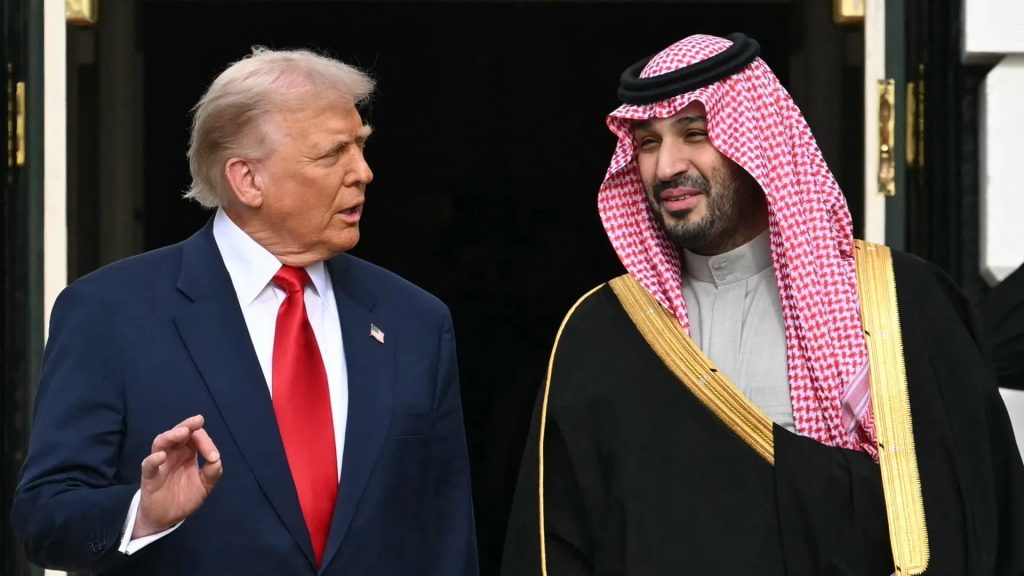
From Washington came a combination of inducements and implicit threats. The Trump administration, eager to frame its Iran policy as a generational realignment of the Middle East, pressed the Crown Prince to translate the Kingdom’s de facto cooperation — expanded overflight permissions, access to King Fahd Air Base — into formal military partnership.
The prize dangled before Riyadh was normalization with Israel, a political achievement that the administration calculated would be transformative domestically and internationally. Trump’s public statements, including his characteristically blunt declaration that the Crown Prince “has to be nice to me,” were not idle bluster; they were calibrated signals of a deeper and more systematic coercion.
From Tel Aviv, the pressure was structural rather than rhetorical. Israeli strategic leadership has long understood that transforming the Iran conflict into a genuinely regional war — one in which the Gulf states were active belligerents rather than anxious bystanders — would serve multiple objectives simultaneously. It would fracture the nascent understanding between Riyadh and Tehran that had been quietly cultivated since the Chinese-brokered détente of 2023.
It would drain the Gulf’s financial and political capital. And, most critically, it would provide the ideological and geopolitical cover for Israeli territorial ambitions across the Levant by reframing the conflict as an existential Sunni-Shia civilizational struggle rather than a dispute over sovereignty and nuclear capability.
Meanwhile, Iran itself — whether by deliberate calculation or strategic overreach — was, in either case, strengthening the case for Saudi restraint. The Islamic Republic’s strike on Prince Sultan Air Base — located a mere twenty-nine kilometers from Riyadh — employed thirty drones and six ballistic missiles, wounded twelve American service personnel, and constituted an act of unmistakable audacity.
It was simultaneously an attempt to demonstrate depth of reach into Saudi territory and a test of Riyadh’s resolve. The destruction of KC-135 refueling aircraft on Saudi soil was not an ambiguous provocation — it was a direct challenge to the Kingdom’s neutrality and dignity.
“True sovereign strength lies not in the readiness to be drawn into others’ wars, but in the wisdom to recognize when restraint is the most powerful weapon in the arsenal.” — The argument of this paper, distilled
That Saudi Arabia did not respond militarily to this assault was, in the eyes of some analysts and many within the Trump administration, an act of weakness. In reality, it was the clearest demonstration of strategic coherence possible. Riyadh understood, with the clarity that its critics lacked, that retaliation would have collapsed the posture of restraint that was safeguarding its most critical economic infrastructure — a point developed in the section that follows.
- The Pillars of Saudi Strategy
The Yanbu Pipeline and the Economics of Restraint
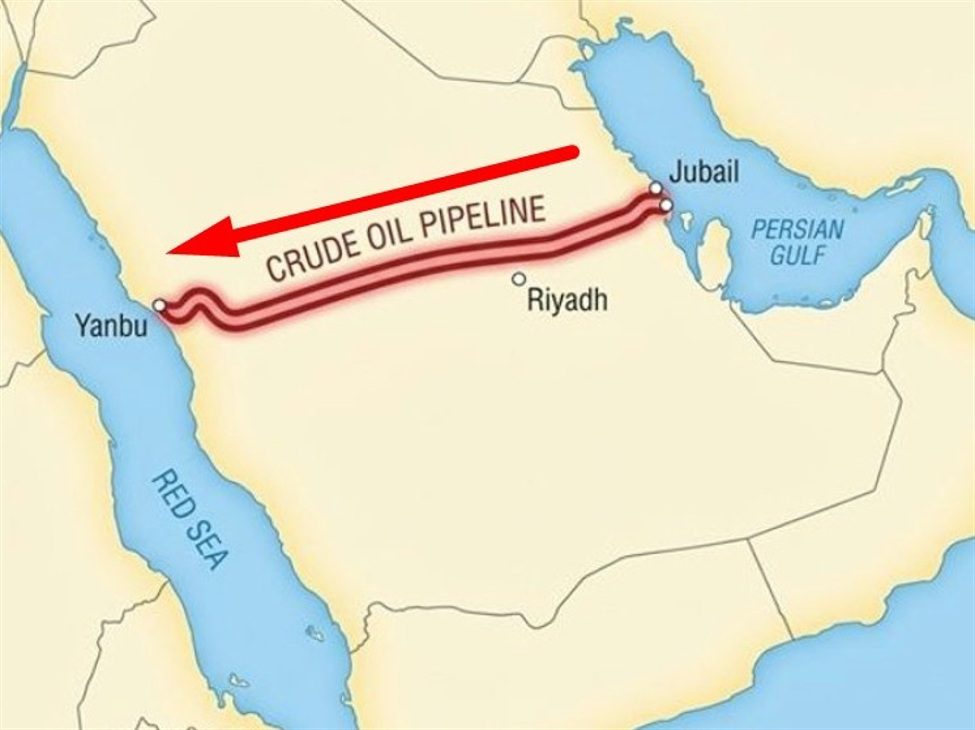
No analysis of Saudi Arabia’s conduct during this crisis is complete without a thorough examination of the East-West Pipeline — the critical infrastructure that has become, in the context of a closed Strait of Hormuz, the Kingdom’s economic lifeline and the material foundation of its strategic patience.
The pipeline, stretching from the Eastern Province’s Gulf-facing fields to the Red Sea port of Yanbu, has a maximum throughput capacity of approximately five million barrels per day in its conventional configuration, though Saudi Aramco’s operational enhancements have expanded effective throughput beyond that baseline.
Before the war’s escalation, Saudi Arabia was exporting approximately ten million barrels per day, with the vast majority transiting the Strait of Hormuz — a chokepoint that, once closed by Iranian military action, threatened to transform the Kingdom’s oil wealth from a strategic asset into a stranded resource.
The figures reported by Bloomberg demonstrate remarkable operational agility. As the Hormuz route became untenable, Saudi exports via Yanbu climbed steadily: from three million barrels per day in the immediate aftermath of the strait’s closure to seven million barrels per day — out of a Saudi maximum capacity of twelve million — as Aramco’s engineers and logisticians adapted to the new reality.
This was not a modest adjustment; it represented a fundamental restructuring of the Kingdom’s entire export architecture within an extraordinarily compressed timeframe.
The strategic implication was unambiguous. The Yanbu pipeline was not merely an infrastructure asset — it was the physical embodiment of Saudi sovereignty during wartime. Any decision to enter the conflict militarily would have invited retaliatory strikes on Yanbu that no air defense system could guarantee to intercept comprehensively, and the destruction or sustained interdiction of that pipeline would have represented an economic catastrophe dwarfing any political benefit that military participation might have secured. Riyadh’s restraint, therefore, was not passivity — it was the rational defense of an irreplaceable national interest.
The Clandestine Understanding with the Houthis
Perhaps the most diplomatically audacious element of Saudi Arabia’s strategy — and the dimension that most unsettled Washington and Tel Aviv when intelligence agencies pieced together its contours — was the clandestine understanding reached between Riyadh and the Houthi movement in Yemen.
The irony was not lost on regional observers. Saudi Arabia and the Houthis had spent years in a grinding conflict that had cost tens of thousands of lives and billions of dollars and had produced one of the world’s most severe humanitarian crises. Yet the logic of the current moment demanded a pragmatic accommodation that neither party would publicly acknowledge but both parties recognized as essential to their respective survival.
According to intelligence assessments compiled from multiple regional sources — assessments that remain unconfirmed by independent reporting — Saudi representatives are believed to have held a series of clandestine meetings with Houthi interlocutors in the weeks preceding the peak of the Iran crisis.
The understanding reached was precise in its architecture: the Houthis would refrain from targeting Saudi oil infrastructure, the Red Sea approaches to Yanbu, or Saudi territory more broadly, in exchange for Riyadh’s continued non-participation in offensive operations against Yemen and its tacit acceptance of the Houthis’ ongoing campaign against Israeli maritime interests.
The practical consequences were immediately discernible to analysts tracking the conflict’s geography. Houthi ballistic missiles flew toward Israeli territory. Houthi naval operations focused on restricting Israeli shipping through the Bab el-Mandeb Strait. Saudi Arabia remained untouched. The symmetry was too precise to be accidental; the operational restraint too disciplined to be coincidental.
Trump’s pointed public statements targeting the Crown Prince — the insistence that “he has to be nice to me” — were, in significant part, a response to U.S. and Israeli intelligence briefings confirming the existence of this arrangement. It was an arrangement that fundamentally disrupted the scenario both Washington and Tel Aviv had constructed: one in which Houthi aggression against Saudi Arabia would force Riyadh’s hand and propel the Kingdom into the war on the American-Israeli side. The clandestine accord had neutralized that mechanism entirely.
Reading the Israeli Strategic Blueprint
Saudi Arabia’s leadership demonstrated a historically informed reading of Israeli strategic intent that went considerably beyond the immediate crisis. The conclusion Riyadh reached — and acted upon — was that Israel’s primary objective in seeking Saudi military participation was not the destruction of Iran’s nuclear capability, which American air power was well-positioned to pursue independently, but the exhaustion and destabilization of the Gulf states as competitors for regional influence.
This interpretation was grounded in a sober assessment of what Riyadh read as the logic of the ‘Greater Israel’ strategic framework — a concept that, while contested in academic literature, has periodically animated elements of Israeli security discourse: specifically, the vision of a Middle East so fragmented by sectarian conflict and inter-Arab exhaustion that Israeli regional dominance would be structurally guaranteed for generations.
A Saudi-Iranian war, regardless of its immediate military outcome, would have served this objective with devastating efficiency. Saudi oil revenues would be redirected toward military expenditure. Saudi political capital would be consumed managing the domestic and regional consequences of open belligerence. The Kingdom’s carefully cultivated relationships across the Muslim world would be permanently poisoned by the optics of an Arab monarchy waging war on a Muslim nation alongside Israel and the United States.
Riyadh’s decision to limit its cooperation to symbolic gestures — airspace access, the nominal presence of American forces at King Fahd Air Base — was therefore the minimum concession required to forestall a diplomatic rupture with Washington, while utterly denying Israel the sectarian war it sought to ignite.
Absorbing Iranian Pressure Without Capitulating to American Demands
The decision not to retaliate against Iran’s strike on Prince Sultan Air Base was, by any conventional military-political calculus, an act of profound institutional discipline. Twelve American soldiers were wounded on Saudi soil. Sophisticated aircraft were destroyed. The symbolic violation of Saudi territorial sovereignty was complete and undeniable.
The pressure within the Trump administration and from certain quarters of the Saudi security establishment to respond was, by all accounts, intense. The argument for retaliation was not without merit: a failure to respond risked communicating to Tehran that Saudi territory could be struck with impunity, potentially inviting further escalation.
Saudi leadership made a different calculation. It recognized that Iranian strikes on Prince Sultan were designed precisely to provoke a response that would justify deeper Iranian engagement against Saudi infrastructure and draw Riyadh irreversibly into the conflict. The restraint demonstrated in the aftermath of the strike was, paradoxically, the most powerful military-political signal Riyadh could send: that the Kingdom would not be baited, would not be manipulated, and would not surrender its strategic autonomy to the emotional logic of retaliation.
Iran, for its part, absorbed the message. Saudi restraint reinforced Tehran’s conviction that Riyadh would not enter the war — a conviction that, while emboldening further Iranian provocations against American forces, paradoxically stabilized the Gulf by removing Saudi Arabia as an active military target.
- The Intelligence Dimension
What Analysts and Agencies Concluded
The picture that emerges from intelligence assessments compiled by both American and Israeli agencies in the final weeks of the crisis’s acute phase is one of growing frustration with a Saudi leadership that proved considerably more strategically autonomous than their interlocutors had anticipated or desired.
U.S. intelligence briefings to the Trump administration concluded that the probability of Saudi Arabia entering active combat was “exceptionally low” barring a direct, sustained assault on the Yanbu pipeline or on Saudi population centers.
The assessment identified two primary triggers for Saudi military engagement: a Houthi attack on oil export infrastructure and a significant Iranian strike on Riyadh or Jeddah. Everything short of these thresholds — including the Prince Sultan strike — was assessed as unlikely to alter Riyadh’s posture.
Israeli intelligence reached similar conclusions, additionally identifying the Saudi-Houthi understanding as the mechanism that had neutralized what had been their most reliable scenario for forcing Riyadh’s hand. The disclosure of this assessment to the Trump administration was, according to multiple regional sources, the proximate cause of the public pressure campaign against the Crown Prince — a campaign that, in its very public nature, represented a departure from conventional diplomatic register and a sign of genuine American frustration.
The intelligence picture also illuminated Iran’s simultaneous communications with Gulf states. Iranian President Masoud Pezeshkian’s public apology to neighboring countries for strikes that had affected civilian targets was not primarily a moral gesture — it was a calculated act of damage control designed to prevent the Gulf Cooperation Council from presenting a unified front against Tehran and to preserve the informal channels of communication with Riyadh that had been patiently constructed since 2023.
- Geopolitical Implications and the New Saudi Doctrine
Evidence and Corroboration Matrix
| Analytical Claim | Evidence & Corroboration | Status |
|---|---|---|
| Saudi refusal to enter active combat | Reuters (15 March 2026) confirms Riyadh declined offensive participation and actively sought diplomatic resolution, even as U.S. military assets expanded within the Kingdom. | Confirmed |
| Clandestine Saudi-Houthi understanding | Not independently confirmed by Reuters; however, Reuters notes that Riyadh communicated directly with relevant actors to safeguard energy infrastructure. Assessment drawn from multiple regional intelligence sources. | Assessed / Unconfirmed |
| Yanbu pipeline as wartime economic lifeline | Confirmed by Reuters and Bloomberg; both report the dramatic reorientation of Saudi oil exports through the Red Sea route as Hormuz transit became untenable. | Confirmed |
| U.S. pressure for normalization with Israel | Reuters reported that Washington sought expanded military cooperation; analysts note normalization was offered as a political incentive, which Riyadh declined to accept. | Confirmed |
| Iranian strikes on Saudi facilities | Confirmed by multiple intelligence sources and satellite imagery analysis; Saudi Arabia absorbed the strikes without retaliatory action. | Confirmed |
The Emerging Saudi Doctrine
What Saudi Arabia demonstrated during this crisis was not merely tactical agility but the crystallization of a coherent sovereign doctrine that marks a significant departure from the Kingdom’s historical role as a reliable partner of American regional strategy.
This doctrine rests on four foundational pillars. The first is the primacy of economic sovereignty: no political objective, however significant, justifies placing the Kingdom’s oil infrastructure at risk. The Yanbu pipeline’s performance during the Hormuz closure was not accidental — it reflected years of quiet investment in strategic redundancy designed precisely for this contingency.
The second pillar is the rejection of sectarian instrumentalization: Riyadh refused to allow the conflict to be framed as a Sunni-Shia confrontation, understanding that such framing would commit the Kingdom to an indefinite and unwinnable religious war that would drain its resources and fracture its relationships across the Muslim world.
The third pillar is what might be termed diplomatic omnidirectionality: the maintenance of substantive communication channels with all relevant actors — Washington, Tehran, the Houthis, Beijing — simultaneously, without allowing proximity to any one interlocutor to foreclose relationships with others.
This approach, which American and Israeli analysts have sometimes characterized as unreliability, is more accurately understood as the exercise of genuine sovereign discretion.
The fourth pillar is the deliberate cultivation of strategic ambiguity: by never definitively committing to any course of action, Saudi Arabia preserved its leverage at every stage of the crisis, ensuring that all parties — American, Israeli, Iranian, and Houthi — had reason to accommodate Riyadh’s preferences rather than risk its active opposition.
The Broader Regional and Global Implications
Saudi Arabia’s conduct during this crisis carries implications that extend well beyond the immediate military and diplomatic context. At the level of regional geopolitics, Riyadh’s demonstrated capacity to resist American pressure while simultaneously managing Iranian provocation establishes a precedent of considerable significance for every state across the broader Middle East.
The message is unambiguous: it is possible to navigate the competing demands of American alliance politics, Iranian deterrence, and Israeli strategic calculation without surrendering sovereignty to any of them.
For the United States, the episode represents a sobering recalibration of expectations. Washington has long operated on the assumption that Saudi Arabia’s security dependence on American military guarantees translated into political leverage deployable at moments of maximum strategic need. The crisis demonstrated the limits of this assumption.
Saudi Arabia accepted American military presence on its territory, granted overflight permissions, and maintained the formal architecture of the alliance relationship — while declining to convert these concessions into the active military partnership Washington required. The relationship endures, but its terms have been implicitly renegotiated.
For Israel, the failure to draw Saudi Arabia into the conflict is a strategic setback of considerable magnitude. The scenario of a Sunni-Shia war that would have permanently redrawn the regional map in Israel’s favor has been forestalled, at least in this instance.
Netanyahu’s calculation that Saudi Arabia could be manipulated into belligerence through a combination of Iranian provocation and American pressure proved entirely incorrect — a miscalculation whose consequences will reverberate through Israeli strategic planning for years.
For China and the broader emerging multipolar order, Saudi Arabia’s conduct validates Beijing’s investment in the 2023 Saudi-Iranian normalization framework. The Chinese-brokered détente precisely provided the diplomatic infrastructure — the backchannel communications, the mutual recognition of red lines, the institutional framework for managing tensions short of open conflict — that enabled Saudi Arabia to navigate the crisis with the sophistication it demonstrated. Beijing can legitimately claim that its regional diplomacy produced tangible and consequential results.
Conclusion: Strategic Autonomy and the Beginning of a New Era
History is rarely kind to those who seek to write its definitive judgments in the heat of events. The Middle East has confounded prophets of transformation before, and the extraordinary complexity of the forces at work in the current moment — Iranian nuclear ambition, Israeli territorial maximalism, American domestic political imperatives, Gulf economic transformation — ensures that the regional architecture will continue to evolve in ways that no single analysis can fully anticipate.
Nevertheless, what Saudi Arabia achieved during this crisis constitutes a landmark of genuine historical significance. Mohammed bin Salman, who has been characterized in Western discourse alternately as a reformist modernizer and an authoritarian consolidator, has now emerged as a strategist of considerable depth and patience.
The caricature of a young Crown Prince eager to demonstrate toughness — the instinct that led, in an earlier chapter, to the costly miscalculation of the Yemen intervention and the political damage of the Khashoggi affair — has given way to something more measured and more formidable.
Saudi leadership understood, with a lucidity that its interlocutors in Washington and Tel Aviv failed to match, that the most consequential power in the Middle East is the power of definition: the power to define the terms of one’s own engagement, to refuse the categories that others would impose, and to insist that the Kingdom’s sovereignty is not a negotiating chip to be exchanged for American security guarantees or Israeli normalization. In a region where external powers have long treated Arab states as instruments of their own strategic ambitions, this insistence represents something genuinely new.
Saudi Arabia has reasserted itself not as a client of American power or a target of Israeli strategy, but as a sovereign actor capable of shaping the Middle East’s future on its own terms.
Contribution to the Literature
This paper makes four contributions to the study of Gulf security politics and alliance theory. First, it identifies infrastructure redundancy — specifically, the capacity to route strategic exports around a contested chokepoint — as a variable that existing patron-client models have systematically neglected. The East-West Pipeline did not merely sustain Saudi revenues; it transformed the structural conditions under which alliance coercion operates, by removing the economic vulnerability on which American leverage had historically depended.
Second, it documents the Saudi-Houthi clandestine understanding as a case study in sub-regional conflict management that bypasses, and partially undermines, the great-power alliance architecture. The logic of this accommodation — in which two parties who have fought a protracted war reach a temporary, operationally precise non-aggression understanding based on convergent interest rather than formal agreement — has received insufficient attention in the literature on intra-Arab conflict.
Third, it introduces the concept of diplomatic omnidirectionality as an analytically distinct posture, differentiated from both classical hedging (passive non-commitment) and dual alignment (seeking benefits from competing patrons). Omnidirectionality requires the active, simultaneous maintenance of substantive channels with all principal actors — a posture enabled by the 2023 détente architecture and one that may prove characteristic of middle-power behavior in a multipolar order.
Fourth, and most broadly, it suggests that the patron-client model requires significant revision when applied to oil-exporting states that have invested in export-route diversification. As energy transition reduces the strategic premium attached to Gulf oil over the coming decades, the economic calculus that has historically grounded American leverage in the region will weaken further. The 2026 crisis may, in retrospect, represent an early signal of a structural shift whose full implications are only beginning to come into view.
The Question That Remains
The question that remains — and that will define the coming years of Middle Eastern geopolitics — is whether this strategic posture can be sustained as the region’s underlying tensions continue to simmer. The Hormuz closure has exposed the fragility of the global energy architecture. Iran’s nuclear program continues to advance.
The Palestinian question, far from being resolved, has been inflamed to a degree that makes any comprehensive regional settlement considerably more difficult to envision. The domestic pressures within Saudi Arabia itself, as Vision 2030 transforms the Kingdom’s economic and social structures, create their own imperatives and vulnerabilities.
But for this moment, in this crisis, Saudi Arabia demonstrated that it is capable of charting its own course through extraordinary turbulence. The trap was laid with care. The pressure was immense. The temptations and the threats were real. And Saudi Arabia did not enter the war.
That choice — the disciplined, patient, strategically coherent choice not to act when every external power was demanding action — may ultimately be remembered as the moment when the Kingdom began to write a different kind of history: not the history of a nation shaped by others’ ambitions, but the history of a sovereign state determining its own place in a transforming world order.
Bibliography
Primary Sources and News Reporting
Bloomberg Energy. (March 2026). Saudi Arabia reroutes oil exports through Yanbu as Hormuz remains closed. Bloomberg Terminal / Energy Desk.
Middle East Eye. (March 2026). Saudi Arabia and UAE inch closer to U.S.-Israeli war on Iran. Middle East Eye Geopolitics Desk.
Reuters World Service. (12 March 2026). U.S. expands military access in Saudi Arabia amid tensions with Iran.
Reuters World Service. (13 March 2026). Analysts: Saudi Arabia unlikely to join offensive operations against Iran.
Reuters World Service. (14 March 2026). Iran’s President Pezeshkian apologizes to Gulf states after strikes.
Reuters World Service. (15 March 2026). Saudi Arabia warns Iran against further attacks, prefers diplomacy.
Reuters/AOL News. (March 2026). Exclusive: Saudi Arabia told Iran not to attack its territory.
Academic and Policy Literature
Al-Rasheed, M. (2023). The Saudi-Iran rapprochement: Implications for Gulf regional order. Middle East Journal, 77(2), 183–201.
Barnett, M., & Levy, J. S. (1991). Domestic sources of alliances and alignments: The case of Egypt, 1962–73. International Organization, 45(3), 369–395.
Brumberg, D., & Salam, A. (Eds.). (2024). Power and change in the Arab world: New perspectives on authoritarian resilience. Georgetown University Press.
Gause, F. G., III. (2010). The international relations of the Persian Gulf. Cambridge University Press.
Gause, F. G., III. (2014). Beyond sectarianism: The new Middle East cold war. Brookings Institution Doha Center Analysis Paper No. 11.
International Crisis Group. (March 2023). Saudi-Iranian détente: What next? Middle East Briefing No. 91.
Khalil, L., & Al-Tamimi, A. (2025). The Houthi question: War, diplomacy, and the limits of coercion in Yemen. Journal of Strategic Studies, 48(1), 45–78.
Lustick, I. S. (1993). Unsettled states, disputed lands: Britain and Ireland, France and Algeria, Israel and the West Bank–Gaza. Cornell University Press.
Mousavian, S. H., & Ramani, S. (2023). Iran and Saudi Arabia: Toward a new regional order? Carnegie Endowment for International Peace Working Paper.
Rubin, L. (2023). Islam in the balance: Ideational threats in Arab politics. Stanford University Press. [Revised and updated edition.]
Shlaim, A. (2014). The iron wall: Israel and the Arab world (Updated ed.). Norton.
Slaughter, A.-M., & Hurd, I. (2025). Legitimacy and the new regionalism: China’s mediation role in the Middle East. International Security, 49(3), 112–145.
Wehrey, F. (2025). The great unraveling: The United States and the Middle East after the Iran conflict. Council on Foreign Relations Press.
Yates, D. A., & Salisbury, P. (2024). Oil, pipelines, and geopolitical leverage: Gulf state energy infrastructure as strategic assets. Energy Policy, 183, 113–128.
— End of Manuscript —