By Professor Habib Al Badawi
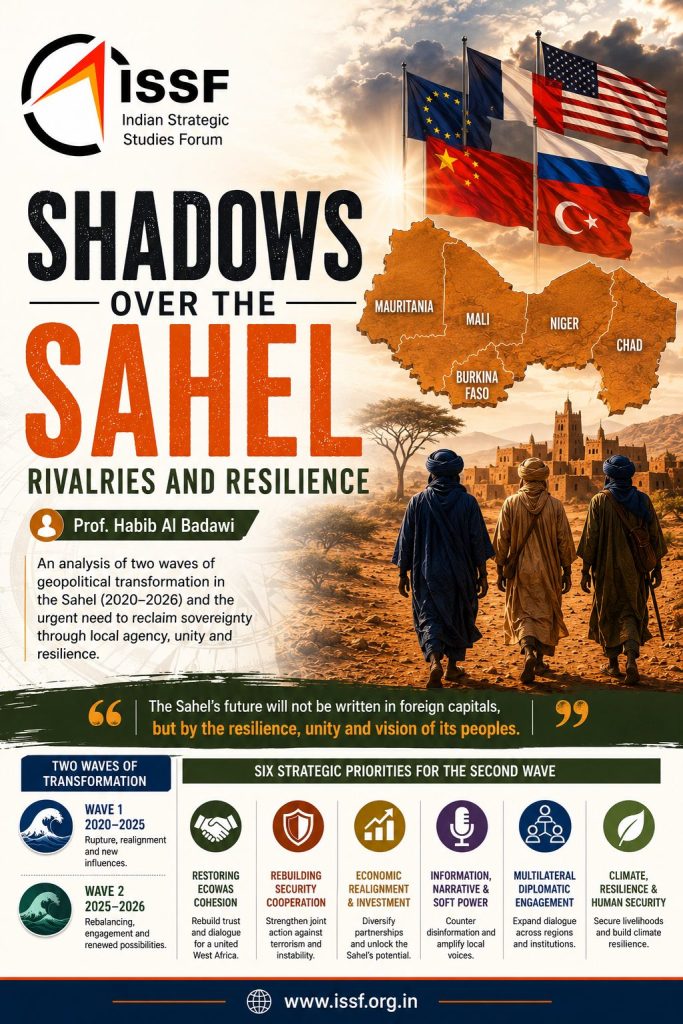
The Sahel occupies an increasingly central position in global geopolitics, where the strategic ambitions of external powers intersect with the fragile realities of local governance. This paper examines two successive waves of geopolitical transformation — the military-coup era of 2020–2025 and the emerging multipolar reordering of 2025–2026 — through a critical Global South lens.
It argues that external interventions, whether military, diplomatic, or economic, have consistently reproduced dependency rather than empowering Sahelian agency. Drawing on recent developments across Mali, Niger, Burkina Faso, and their regional neighbours, the paper contends that genuine stability requires a reimagined sovereignty — one defined not by compliance with external agendas but by the autonomous articulation of local visions for development and security__ Prof. Habib Badawi
- Introduction
The Sahel today stands as one of the most contested frontiers of global politics, where the ambitions of external powers collide with the fragile realities of local governance. Stretching from Mauritania to Chad, this vast belt of desert and savannah has become a crucible of overlapping crises: insurgency and terrorism, climate-induced displacement, resource competition, and the erosion of state sovereignty.
Global actors — whether traditional powers like France and the United States, or emerging players such as Russia, China, and Turkey — view the Sahel through the lens of strategic opportunity. For some, it is a security buffer against transnational extremism; for others, a reservoir of untapped mineral wealth and geopolitical leverage. Yet these ambitions persistently clash with the lived realities of Sahelian societies, where communities struggle for survival amid weak institutions, fractured identities, and contested borders.
The Sahel’s defining asymmetry lies in the gap between external projection and local experience: external powers project influence through military bases, resource contracts, and diplomatic initiatives, while local actors navigate the paradox of sovereignty — asserting independence rhetorically, yet depending on external intervention materially. This dynamic produces a cycle of dependency and resistance in which global ambitions amplify local fragilities rather than resolve them.
At its core, the Sahel is not merely a peripheral zone of instability but a central stage in the reconfiguration of world order. It embodies the tension between multipolar competition and regional resilience, between the rhetoric of sovereignty and the reality of external entanglement. To understand the Sahel is to grasp the broader logic of contemporary geopolitics: the struggle to reconcile global ambitions with local realities in a world where power is diffuse, contested, and deeply uneven.
“To understand the Sahel is to grasp the broader logic of contemporary geopolitics: the struggle to reconcile global ambitions with local realities in a world where power is diffuse, contested, and deeply uneven.”
- Two Waves of Geopolitical Transformation
The Sahel is undergoing a second wave of geopolitical transformation, driven by increasingly complex international and regional dynamics that are redrawing the map of influence. This shifting landscape is part of a broader strategic framework in which international competition has intensified among major powers — the United States, China, Russia, and France — alongside emerging regional actors such as Turkey.
The first wave emerged in 2020, when a series of military coups in Mali, Niger, and Burkina Faso brought a new military elite to power. These governments fundamentally reoriented their countries’ foreign policies, culminating in the formal withdrawal from the Economic Community of West African States (ECOWAS) bloc. Relations with the regional neighbourhood deteriorated sharply. A simultaneous diplomatic rupture with France and the broader West accelerated the decline of Western influence, including the expulsion of French and international forces from their military bases — a development that corresponded with a significant rise in Russian and Chinese influence across the region.
The second wave presents a markedly different dynamic. The complexities of the regional context and internal pressures in most Sahelian states are now compelling their new rulers to open channels of communication with a wider range of actors, including neighbouring states and powers such as the United States, France, and the European Union. This trend aligns with a genuine desire on the part of Washington and Paris to rebuild relations with the region — and thereby recover strategic influence — in order to contain the growing Russian and Chinese presence in the Sahel.
Yet the risk of the Sahel becoming an arena of open conflict between international and regional actors remains acute, threatening to compound, rather than resolve, the region’s security and governance crises.
- Key Developments in the Second Wave
The second wave of transformations is defined by six strategic developments at the regional and international levels.
- Restoring ECOWAS Cohesion
ECOWAS has pursued sustained dialogue with Mali, Burkina Faso, and Niger since their permanent withdrawal from the bloc in 2025. Senegalese President Bassirou Diomaye Faye undertook two diplomatic initiatives in July 2024 to facilitate rapprochement, followed by Ghanaian President John Mahama’s tour of the three countries in March 2025. Both efforts failed to persuade the ruling military authorities to reverse their withdrawal.
In March 2026, ECOWAS appointed former Guinean Prime Minister Lansana Kouyaté as a new mediator, tasked with reopening channels of dialogue between the two parties. This appointment reflects the bloc’s determination to overcome the division in West Africa and rebuild bridges of trust after a prolonged period of tension. It may also signal a shared willingness to move beyond the polarising dialectic over relations with France and Russia, and to focus instead on bridging the institutional rift. Nevertheless, significant obstacles persist. The Sahel Alliance governments have maintained that their withdrawal is final; their readiness to deepen functional cooperation with ECOWAS in security and trade does not appear to include formally revisiting their membership status.
The urgency of this process is underpinned by serious security concerns. ECOWAS is acutely aware of the scale of the security challenges confronting the Alliance countries, given the expansion of al-Qaeda and Islamic State (ISIS) affiliates across all three states. Regional neighbours fear the diffusion of instability into coastal West Africa, threatening the wider region’s peace and prosperity.
- Rebuilding Regional Neighbourhood Relations
Both the Sahel Alliance states and their neighbours recognise that the escalation of terrorist activity across the region demands strengthened bilateral cooperation and coordination in the security field. Beyond security, both sides are equally invested in protecting trade flows by stabilising cross-border movement — the borders being a critical channel for food supply across the region.
In February 2026, Burkina Faso and Ghana signed a security cooperation agreement focused on counter-terrorism, following a series of attacks in northern Burkina Faso by Jama’at Nusrat al-Islam wal-Muslimin (JNIM), al-Qaeda’s Sahelian affiliate. The attacks killed dozens of civilians, including seven Ghanaian nationals. In response, the two countries agreed to establish a joint border redemarcation committee and to develop a joint plan to prevent terrorist infiltration across their shared border.
In a related development, intelligence reports from March 2026 indicated President Mahama’s intention to position Ghana as a regional mediator between the Sahel Alliance governments and ECOWAS, with the aim of reviving security talks and proposing a new regional cooperation framework. The three Alliance states received formal invitations to participate in Ghana’s High-Level Consultative Conference on Regional Cooperation and Security, reinforcing Accra’s commitment to strengthen ties with its northern neighbours.
Mali’s transitional government, meanwhile, recognises the growing threat posed by JNIM and ISIS affiliates across its territory. This has prompted interim President Assimi Goïta to seek closer ties with Senegal and Guinea, pursuing frameworks for regional security and strategic cooperation to mitigate the expanding influence of these armed groups.
In a significant economic gesture, Côte d’Ivoire eased customs procedures for goods destined for Burkina Faso and Mali from 31 March 2026, replacing prior restrictions with a customs visa system. Given the strategic importance of the port of Abidjan as a primary gateway for both landlocked nations’ foreign trade, this move carries substantial economic and diplomatic weight.
- French Moves to Rebuild Influence
France is acutely conscious of how sharply its image and strategic position have deteriorated across West Africa, and of the risks posed to its long-term interests by the rise of rival powers — Russia, China, and Turkey — in the region. Paris is now pursuing a recalibrated strategy of political, economic, and security engagement aimed at gradually restoring French influence in West Africa and the Sahel.
France is seeking to present itself in a new light, adopting a discourse that emphasises mutual respect and shared opportunity rather than the paternalistic frameworks of the past. The French government has begun updating its comprehensive Africa Strategy for 2026, as reflected in the French National Strategic Review through 2030, published by the French Secretariat for Defence and National Security. The document underscores the centrality of Africa to French strategic interests while also acknowledging the associated risks. In parallel, the intensity of high-level official visits to Senegal, Central Africa, Côte d’Ivoire, Nigeria, and others — together with the appointment of a dedicated French Special Envoy for Africa — reflects a more proactive diplomatic posture.
This diplomatic recalibration is accompanied by a reassessment of France’s military and security doctrine in Africa, which is shifting away from permanent military bases toward a model anchored in partnerships, military training, intelligence sharing, and capacity-building. In March 2026, Paris launched a new military training programme in Central Africa focused on environmental protection and security, with French military personnel training teams from Benin, Cameroon, Côte d’Ivoire, Ghana, Chad, and Gabon.
France has also sought to revive security ties with Senegal. Officials from both countries have held informal talks on renewing defence agreements, even following the withdrawal of French troops from their bases in Dakar in July 2025. Intelligence cooperation has continued and deepened since August 2025, when the head of the French National Intelligence Service visited Dakar; his Senegalese counterpart subsequently visited Paris in November of the same year.
Paris, however, faces serious headwinds. Regional resistance to the renewal of French influence remains strong. Statements made in April 2026 by former French Army Chief of Staff François LeContre suggesting a possible return of French colonial-era influence in the Sahel were swiftly rejected by Niger’s Defence Minister, General Salifu Modi, who affirmed that any such attempt would face resolute resistance.
- American Efforts to Reposition in the Sahel
The United States recognises the strategic risks of ceding the Sahel to China and Russia — both in terms of threatened strategic interests and the prospect of Beijing and Moscow consolidating control over the region’s critical minerals. Despite a relative withdrawal over the preceding two years — culminating in the departure of US forces from their base in Agadez, Niger, in August 2024 — Washington is seeking to re-engage through the portal of security and intelligence cooperation. This reorientation is driven partly by the limited effectiveness of the Sahel Alliance’s own security operations against expanding terrorist organisations, and by the Africa Corps’ failure to contain the deteriorating security situation.
Reports from March 2026 indicated that Washington was close to concluding a security agreement with the Malian government that would allow US forces to resume using Malian airspace for intelligence-gathering and monitoring of terrorist movements in border areas. This follows bilateral cooperation initiated in 2025, in which Washington provided intelligence enabling the Malian army to target a senior JNIM commander. The Deputy Commander of US Africa Command (AFRICOM), John Renan, stated in January 2026 that Washington continues to cooperate with the armies of the Sahel Alliance states, exchanging intelligence to target terrorist concentrations.
In February 2026, as part of implementing a bilateral agreement — and responding to a key Malian demand — the US administration lifted sanctions on Malian Defence Minister Sadio Camara. The sanctions had been imposed following the military coups of 2020 and 2021, when Washington alleged that Camara had facilitated links between the transitional government and Russian Africa Corps personnel. The lifting of sanctions signalled a meaningful shift in Washington’s approach.
The visit of US Special Envoy for Africa, Nick Chequer, to Bamako — and his meeting with Malian Foreign Minister Abdoulaye Diop — embodied Washington’s desire to chart a new bilateral path that moves beyond the perceived policy failures of the Biden administration. The meeting of Malian Prime Minister Abdoulaye Maïga with US Ambassador Rachna Korhonen in December 2025, in which she affirmed Washington’s commitment to continued engagement in development and governance, further demonstrated the Trump administration’s intent to rebuild relations on a basis of mutual respect.
Some observers have linked Washington’s security overtures to US efforts to locate a pilot kidnapped by al-Qaeda in Niger in 2025, believed to have been transferred to JNIM-controlled areas in Mali. Yet the broader logic is strategic: the Trump administration’s approach is anchored in a principle of ‘security for minerals,’ seeking to acquire access to critical mineral resources in the Sahel — particularly in Mali — while countering Russian influence and limiting the expansion of Chinese mining companies. Washington also reportedly seeks to sever any emerging links between Sahelian governments and Iran, amid concerns over potential access to uranium from the region.
Mali’s lithium production is projected to reach approximately 590,000 tonnes in 2026, positioning it as a major player in global energy supply chains. Its uranium deposits are currently dominated by Chinese and Russian interests — making Mali a priority target for a US administration committed to securing American critical mineral supply chains in Africa. Washington is also expanding its military presence in West Africa more broadly. Reports suggest a potential agreement with Côte d’Ivoire to establish a drone base in the Barami region; US forces and drones have been stationed in Accra since late 2025 and are believed to have participated in airstrikes targeting ISIS operatives in northern Nigeria.
- Expanding Chinese Presence
China has been systematically deepening its presence in the Sahel over recent years, capitalising on the decline of Western and French influence. Senegal serves as Beijing’s primary gateway into West Africa; from there, China has pursued engagement with the Sahel Alliance states across multiple dimensions. The economic dimension remains primary — particularly through the extension of the Belt and Road Initiative into sub-Saharan Africa — but China’s Sahel strategy is acquiring a growing security dimension that marks a fundamental shift in its approach to the continent.
In 2025, China sent its first military attaché to Niger, signalling an intent to deepen strategic ties with Niamey beyond purely economic engagement. In April 2026, Beijing delivered a new shipment of military equipment to Mali — possibly including short-range air defence systems — as part of a bilateral military cooperation relationship that centres on the supply of Chinese equipment and military training. This comes as Mali seeks to modernise its armed forces in response to escalating security challenges across the country and the wider Sahel.
- Growing Regional Engagement: Turkey and the UAE
The Sahel, with its vast mineral wealth and shifting security landscape, has become an open arena for regional powers seeking strategic footholds. The decline of French and EU influence, the proliferation of terrorist activity, and the appetite of Sahelian governments for alternative security and economic partnerships have created conditions that Turkey and the United Arab Emirates have been quick to exploit.
Turkey has expanded its presence across multiple domains — diplomacy, trade, infrastructure, education, health, and humanitarian action — steadily building influence and goodwill across the region. The entry of Turkish companies into infrastructure and services sectors laid the foundation for a broader partnership. Scholarship programmes, cultural exchanges, and educational links have deepened Ankara’s ties with local elites and youth, while projects delivered through the Turkish Cooperation and Coordination Agency (TIKA) have positioned Turkey as a significant development partner.
Most consequentially, Turkey has cultivated defence and security partnerships with Sahelian governments, with Turkish combat drones serving as a flagship instrument of this security diplomacy. In September 2025, Niger announced the acquisition of Turkish Aksungur drones, with approximately twelve military personnel trained in Ankara to operate them. During the meeting of Turkish Defence Minister Yaşar Güler and his Nigerien counterpart, Salifu Modi, on 7 April 2026, the two countries signed a security protocol on field military training — an extension of the bilateral military cooperation agreement first concluded in 2020. Mali and Burkina Faso have also acquired the Turkish Akıncı combat drone, which has entered active service against terrorist groups in both countries, reflecting a growing regional dependence on Turkish defence industries. On 18 April 2026, Turkey and Nigeria concluded a security agreement on the sidelines of the Fifth Antalya Diplomatic Forum, encompassing counter-terrorism cooperation, defence industry training, and the provision of training for approximately 200 Nigerian military personnel in Ankara.
The UAE is simultaneously strengthening its position in the Sahel, expanding cooperation in security, infrastructure, minerals, and humanitarian assistance. Abu Dhabi has become a notable supplier of military hardware to the region. Reports indicate that Burkina Faso dispatched a delegation from its National Intelligence Agency to Dubai to negotiate the acquisition of military aircraft and helicopters for use in counter-terrorism operations.
- Sahelian Perspectives and Strategic Calculations
The complex interplay of regional and international forces casts a distinct shadow over the Sahelian states themselves, whose strategic calculations diverge significantly from the frameworks imposed by external actors.
The gradual openness of the Alliance states toward rebuilding relations with a broader range of partners, after years of confrontational posturing, signals a pragmatic desire to expand their international alliances. This may strengthen counter-terrorism cooperation, attract foreign investment, and access international expertise to support economic recovery. At the same time, disillusionment with the Russian partnership is deepening: the Africa Corps has failed to deliver the security gains promised, while credible reports — including those cited by Western sources, albeit unverified — allege the involvement of Russian personnel in human rights violations against civilian populations in Mali. Such allegations, if sustained, risk provoking popular unrest that could further destabilise the political and security environment.
On the ECOWAS question, the Malian Foreign Minister, Abdoulaye Diouf, reaffirmed in April 2026 that withdrawal from the bloc is final, and that ongoing diplomatic contacts are aimed exclusively at strengthening cooperation in areas of common interest such as security and trade — not at revisiting membership. The regional mediation efforts of Senegal, Ghana, and Togo have not produced a shift in the Alliance states’ formal position.
With respect to Washington, the Alliance governments acknowledge that the Trump administration’s overtures represent an implicit recognition of the policy errors of its predecessor. Yet concerns about the volatility of US diplomacy under President Trump persist. Distrust runs deep, particularly following reports that Washington has conditioned its engagement on two demands: a return to constitutional order and the termination of contracts with the Russia’s Africa Corps. Reports of US attempts to establish covert communication channels with Mali’s political opposition have further complicated the relationship. Nonetheless, a sustained US rapprochement — particularly with Mali — carries genuine strategic value: it could ease Bamako’s international isolation, rehabilitate its international image, and attract renewed foreign investment.
France, meanwhile, continues to face deep-seated regional resistance that may fundamentally constrain its capacity to rebuild influence. The negative perception of French policy is rooted not in recent grievances alone but in the long arc of colonial history and the post-independence neocolonial order — what scholars in the tradition of Walter Rodney have termed the structural underdevelopment embedded in North–South relations. Statements such as those made by former French Army Chief LeContre in April 2026 only reinforce the perception that Paris has not fully reckoned with this legacy.
- A Critical Global South Reading
The Sahel is not simply a regional crisis zone; it is a mirror of the structural inequities that define the Global South’s position in the international system. External interventions — whether military, economic, or diplomatic — have consistently been justified in the language of ‘stability’ and ‘development.’ Yet, from the perspective of the Global South, these interventions reproduce dependency rather than empowerment. Sovereignty becomes rhetorical, while resource wealth is extracted under the guise of partnership.
This dynamic reflects what Achille Mbembe has described as the ‘politics of enmity’ embedded in postcolonial African governance — a condition in which external actors define the terms of security, development, and legitimacy, while local agency is either co-opted or marginalised. The Sahel’s mineral wealth — lithium, uranium, gold — is pursued by great powers not as a shared resource for regional development but as a strategic asset to be secured and controlled. The ‘security for minerals’ formula advanced by Washington is the most transparent articulation of this logic, but it is far from unique to the United States.
The Sahel equation thus exposes a deeper paradox: global ambitions are pursued through strategies that undermine local agency, while local realities are narrated as deficiencies requiring external correction. This dynamic reflects the broader asymmetry of North–South relations, where the Global South is cast as a perpetual site of crisis management rather than a co-author of global order.
A critical Global South perspective insists on reframing the Sahel not as a passive recipient of external designs but as an active geopolitical actor. Communities in Mali, Niger, Burkina Faso, and beyond are not merely victims of instability; they are agents negotiating survival, resistance, and adaptation in ways that challenge the imposed templates of governance and development. Their struggles highlight the need for a reimagined sovereignty — one not measured by compliance with external agendas but by the capacity to articulate autonomous visions of security and prosperity.
Conclusion
The second wave of geopolitical transformation in the Sahel unfolds within a regional environment of exceptional complexity. It is likely to draw an expanding constellation of international actors into the region under the pretext of confronting security threats, further intensifying competition for the Sahel’s strategic resources and minerals. The Sahel has become a strategic theatre in which major powers seek to redefine their roles in Africa and the wider global order — pursuing security partnerships as foundations for economic partnerships, and economic partnerships as mechanisms for resource and energy control.
Overall, the Sahel has become a strategic theatre for multiple international actors seeking to redefine their role in Africa. Security partnerships serve as the gateway to economic partnerships, which in turn translate into control over resources, critical minerals, and energy in a region of growing global significance.
The Sahel equation is emblematic of the wider struggle of the Global South: the contest between imposed global ambitions and the assertion of local realities. Resolving this equation requires more than policy prescriptions — it demands a reconfiguration of the global order itself, one in which the South is no longer the periphery of international relations but a central voice in shaping its future.
“Resolving the Sahel equation demands a reconfiguration of the global order itself — one in which the South is no longer the periphery of international relations, but a central voice in shaping its future.”
Finally: The Sahel is not a crisis zone. It’s a mirror reflecting who really controls the Global South’s resources, sovereignty, and future.
The second wave has begun 🌍
Notes
[1] French Secretariat for Defence and National Security, Revue Nationale Stratégique (Paris, 2024–2026).
[2] Diplomatic intelligence reports cited by regional security analysts, March 2026 (sources confidential).
[3] Statement by Deputy Commander, AFRICOM, General John Renan, January 2026.
[4] U.S. Department of State, travel advisories and visa policy updates, October 2025.
[5] U.S. Embassy in Mali, official communiqué following Nick Chequer’s visit to Bamako, 2026.
[6] Malian Prime Minister’s Office, readout of meeting with U.S. Ambassador Rachna Korhonen, December 2025.
[7] Regional intelligence assessments, cited by West African security analysts, 2026 (sources confidential).
[8] Mbembe, Achille. On the Postcolony. Berkeley: University of California Press, 2001.
[9] Reports from West African security monitoring networks, late 2025–early 2026.
[10] Chinese Ministry of Defence, press release on military cooperation with Mali, April 2026.
[11] African Union Peace and Security Council, quarterly threat assessment, Q1 2026.
[12] Turkish Ministry of National Defence, official communiqués, 2025–2026.
[13] Joint press statement, Turkish–Nigerien Defence Ministerial, Ankara, 7 April 2026.
[14] Fifth Antalya Diplomatic Forum, closing statement, 18 April 2026.
[15] West African security analyst briefings, cited in regional defence publications, 2026.
[16] Rodney, Walter. How Europe Underdeveloped Africa. London: Bogle-L’Ouverture Publications, 1972.