Abstract
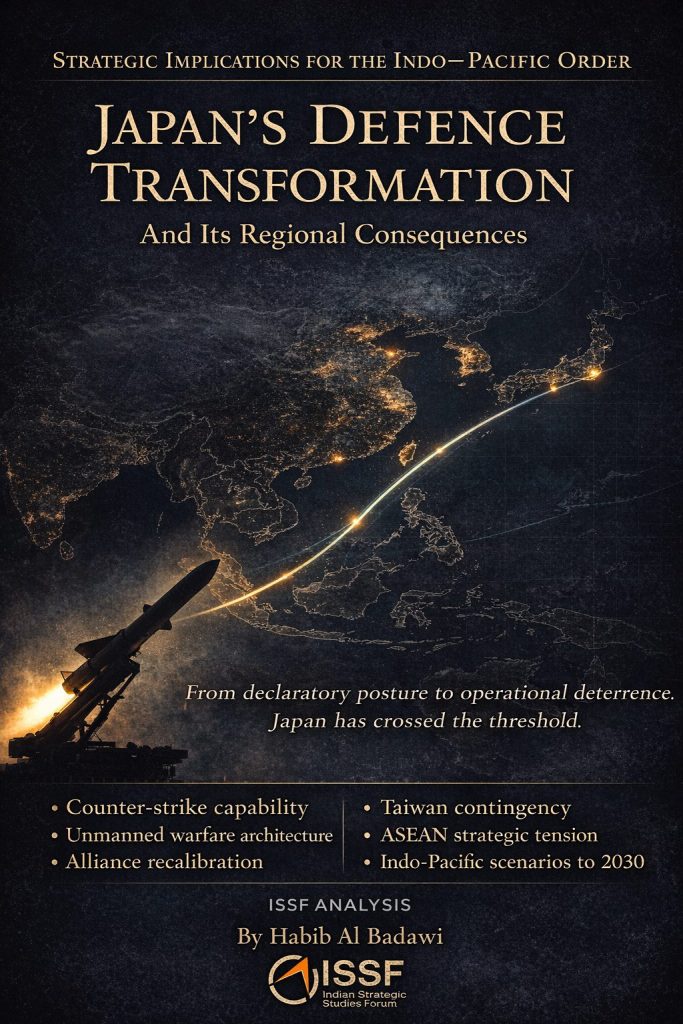
This paper examines the strategic implications of Japan’s ongoing defence transformation for the Indo-Pacific regional order through 2030. Drawing on Japan’s 2022 strategic documents, the 2025–2026 procurement cycle, and the evolving Taiwan contingency, it argues that Japan has crossed a threshold from declaratory posture to fielded operational counter-strike capability — a transition with qualitative consequences for regional deterrence dynamics.
The paper analyses three structural features of Japan’s build-up (range, unmanned architecture, and institutional lock-in), assesses the Taiwan variable and Beijing’s Ryukyu sovereignty gambit, examines Southeast Asia’s structural tension between Japan’s trust premium and its bloc-alignment trajectory, and presents three probability-weighted scenarios for the regional order through 2030. Five analytical recommendations are offered to policymakers and strategic analysts.
The Doctrine Shift: What Has Actually Changed
Japan’s 2022 National Security Strategy (NSS) established the theoretical framework for counter-strike capability (Japan Cabinet Secretariat, 2022). What the 2025–2026 procurement cycle has done is convert doctrine into hardware, and hardware into the operational capability that underpins credible deterrence.
This is the critical analytical distinction that much commentary on Japan’s ‘rearmament’ misses: this transition — the threshold at which deterrence becomes credible to an adversary — is neither linear nor automatic, and Japan has now crossed this threshold (Japan Ministry of Defense [MOD], 2022a).
Three structural features distinguish this build-up from prior Japanese defence modernisation (Japan MOD, 2022b).
First, the range threshold: upgraded Type-12 missiles at approximately 1,000 km place Chinese naval facilities at Zhoushan and Sanya within conventional strike range from Japanese territory without overflight of third-party airspace — a qualitative, not merely quantitative, change in Japan’s strategic reach (Japan MOD, 2025).
Second, the unmanned architecture (SHIELD): by 2028, Japan is projected to field persistent Intelligence, Surveillance, and Reconnaissance (ISR) and strike-capable drone coverage across the Western Pacific through its dedicated unmanned systems architecture (SHIELD), substantially reducing its dependence on manned aircraft in contested airspace (SIPRI, 2024).
Third, institutional lock-in: Japan’s defence posture is now embedded in four multilateral frameworks — the Global Combat Air Programme (GCAP), the Australia Reciprocal Access Agreement, the Japan–NATO liaison mission, and the EU Security and Defence Partnership — making any reversal contingent on the consent of multiple allied capitals, not Tokyo alone.
The 2022 Policy Reorientation in Context
In December 2022, Prime Minister Fumio Kishida’s government revised three foundational strategic documents — the NSS, the National Defense Strategy (NDS), and the Medium-Term Defense Program (MTDP) — following months of inter-agency deliberation (Yoshida & Murakami, 2022).
The reorientation was driven by a convergence of threat perceptions: the intensifying North Korean ballistic missile programme, the People’s Republic of China’s accelerated military build-up and coercive behaviour in the East and South China Seas, and the lessons drawn from Russia’s invasion of Ukraine in February 2022.
The strategic logic was articulated by Prime Minister Kishida in a June 2022 address: “Ukraine today may be East Asia tomorrow.” The first Trump administration’s burden-sharing demands compounded Tokyo’s sense of vulnerability, as President Trump had publicly characterised the US–Japan Mutual Security Treaty as asymmetric and demanded both higher defence expenditure and an increased Japanese financial contribution to the cost of forward-stationed American forces.
The most consequential doctrinal change in the 2022 package is the formal acceptance of counter-strike capability — defined as the capacity to engage enemy bases or command systems that are preparing, or have already conducted, attacks on Japan (Japan MOD, 2022a).¹
This represents a fundamental reframing of the Self-Defence Forces’ (SDF) mandate: from reactive defence against imminent attacks to proactive deterrence through the credible threat of pre-emptive action against a planned hostile assault.
India–Japan Defence Cooperation
Located at opposite ends of the Indo-Pacific and sharing China as their primary strategic concern, Japan and India maintain a “Special Strategic and Global Partnership” and a framework of agreements and dialogues intended to promote defence cooperation (Smith, 2019).
The relationship, however, remains below its strategic potential. Efforts to deepen defence technology collaboration have been constrained by both India’s strategic autonomy posture and Japanese export-control caution (Smith, 2019). The ShinMaywa US-2 amphibious aircraft co-production programme stalled, and India’s earlier interest in the Soryu-class submarine did not advance.
Current active cooperation includes agreements to transfer stealth mast technology (UNICORN) and to develop an advanced underwater surveillance system. The potential to combine Japan’s advanced manufacturing technology with India’s production base and strategic geography — particularly in naval systems — remains substantially untapped.
Capabilities, Technology, and Military Modernisation
Policy shifts have been accompanied by a comprehensive capability development programme (Osaki, 2023). Tokyo has moved to acquire 400–500 Tomahawk land-attack cruise missiles from the United States and to develop indigenous long-range standoff systems, principally upgraded Type-12 anti-ship missiles with an extended range of approximately 1,000 km (Yeo, 2025).
Simultaneously, Japan has expanded its missile defence architecture — comprising Aegis-equipped destroyers, land-based interceptors, and space-based persistent ISR — to detect and defeat saturating ballistic and cruise missile attacks.
Significant investment is also directed at unmanned maritime and aerial systems and offensive and defensive cyber capabilities (Japan MOD, 2025). Enhanced cyberwarfare capacity includes a planned expansion of SDF cyber specialists to approximately 20,000 personnel.
The most substantial capability gains are projected in maritime systems. Japan already operates a technologically advanced naval force, though considerably smaller than that of the People’s Liberation Army Navy (PLAN) in aggregate displacement (see Table 1).
Table 1
China vs. Japan — Naval Comparison (Approximate, 2024)
| Category | China (PLAN) | Japan (JMSDF) |
|---|---|---|
| Aircraft Carriers | 3 (+ building) | 0 (2 helicopter destroyers) |
| Destroyers / Frigates | ~80 | ~36 |
| Submarines | ~60 | ~22 |
| Corvettes / Patrol | ~50 | ~6 |
| Total Displacement | ~2.0 million tons | ~450,000 tons |
Note. SIPRI Arms Transfers Database (2024); Japan MOD FY2026 budget documentation (Japan MOD, 2025; SIPRI, 2024).
Japan’s pace of technological development is exceptional. Its Taigei-class submarines — equipped with lithium-ion battery technology — are among the most capable conventional submarines operating today (Yamaguchi & Kim, 2025).
These vessels offer significantly greater underwater endurance, faster recharging cycles, and reduced acoustic signatures compared with conventional Air Independent Propulsion (AIP) systems. Unlike AIP — which relies on stored oxygen via Stirling engines or fuel cells — lithium-ion technology is not oxygen-constrained, substantially extending submerged endurance and rendering AIP effectively redundant for submarines requiring prolonged submerged operations. Four Taigei-class vessels have been commissioned since 2022, with four additional hulls expected by 2029.
Tokyo’s hypersonic programme represents another critical technological frontier (IR & Markets Collective, 2026). The Hyper Velocity Guided Projectile (HVGP) — in development since 2018 — is scheduled for initial deployment in 2026.
Its first variant has a range of approximately 900 km, with future configurations projected at 2,000–3,000 km. A complementary US–Japan co-development programme — the Glide Phase Interceptor (GPI) — is designed to defeat hypersonic missiles in their mid-course phase and is slated for deployment aboard Aegis-equipped destroyers in the early 2030s.
In September 2025, Japan conducted the first successful at-sea test-firing of an electromagnetic railgun (Gady, 2025). These systems are intended primarily for defence against hypersonic cruise missiles and as a high-penetration anti-ship weapon; Japan is positioned to be the first country to deploy them operationally.
Japan’s air power modernisation is anchored by GCAP, a trilateral programme with the United Kingdom and Italy to develop a sixth-generation combat aircraft for service by 2035 (Gady, 2025). Japan is also pursuing advanced unmanned underwater vehicles (UUVs), a field with transformative potential for submarine and surface combatant tracking.
Alliance Centrality in Japan’s Defence Posture
Japan’s capability build-up is projected to reach operational maturity in the 2030s, yet even then it will remain structurally dependent on the US–Japan alliance — a dependence made more acute, not less, by the PLA’s continuing advantage in hypersonic technology (Lowy Institute, 2024).
Through doctrinal reorientation and investment in advanced systems, Japan is signalling to Washington that it is a capable, burden-sharing ally — an explicit rebuttal of the ‘free-rider’ characterisation advanced by Trump administration officials across both terms.
The second Trump administration’s National Security Strategy reflects this expectation directly:
Given President Trump’s insistence on increased burden-sharing from Japan and South Korea, we must urge these countries to increase defense spending, with a focus on the capabilities — including new capabilities — necessary to deter adversaries and protect the First Island Chain. (United States National Security Council [NSC], 2025, p. 24)
The First Island Chain — encompassing the Kuril Islands, the main Japanese archipelago, Okinawa, Taiwan, and the Philippines — is central to Japanese security planning and a principal driver of friction in the Beijing–Tokyo relationship. Japan has committed to raising its defence budget from approximately 1 percent of GDP to 2 percent in FY2025, with political signals of willingness to exceed this threshold (Osaki, 2023).
On its projected spending trajectory, Japan is expected to emerge as the world’s third-largest defence spender within the decade.
The Taiwan Variable: From Risk to Live Crisis
The Takaichi government publicly characterised a Taiwan contingency as a potential ‘survival-threatening situation’ for Japan — the legal trigger for Japan’s broadest collective self-defence authorities under the 2015 security legislation (Reuters, 2025a).
This was a calculated signal to Washington, Beijing, and Tokyo’s treaty partners that Japan regards the Taiwan Strait as a vital national interest. The Chinese response outpaced Tokyo’s diplomatic capacity to manage it — in both speed and severity.
The most analytically significant, and insufficiently examined, element of the resulting escalation sequence is Beijing’s Ryukyu sovereignty gambit (Strangio, 2025). By publicly questioning Japan’s sovereignty over the Ryukyu Islands — home to Kadena Air Base, the largest US Air Force installation in East Asia — Beijing introduced a territorial dimension with direct implications for Article V of the US–Japan Mutual Security Treaty.
The treaty’s precise applicability to a sovereignty dispute, as opposed to an armed attack, remains a matter of legal interpretation. This is not a frivolous claim. It is a calibrated pressure instrument designed to complicate American decision-making and deter Japanese assertiveness without requiring a military move — deterrence by ambiguity deployed against Japan’s own deterrence posture.
The Trump administration reportedly urged Prime Minister Takaichi to exercise restraint — even as Tokyo publicly maintained a forward posture — introducing an additional layer of strategic uncertainty (Reuters, 2026). Tokyo is now managing a deterrence architecture in which the reliability of the alliance anchor is itself a variable: a condition without precedent in the postwar US–Japan relationship.
Southeast Asia: Opportunity, Liability, and the Trust Premium
Southeast Asia represents simultaneously Japan’s greatest strategic asset and its most acute source of vulnerability. The asset is trust: across five consecutive years of ISEAS State of Southeast Asia surveys, Japan has maintained its standing as the region’s most trusted major power — a position that the PRC, despite its economic dominance, has never achieved (ISEAS–Yusof Ishak Institute, 2025; ISEAS–Yusof Ishak Institute, 2024). The Lowy Institute Southeast Asia Influence Index 2025 corroborates this assessment, registering Japan’s soft power standing as the highest among external actors in the region (Lowy Institute, 2025).
The liability is structural: the same surveys reveal deep regional aversion to bloc politics, Cold War framing, and binary alignment choices between major powers (ISEAS–Yusof Ishak Institute, 2025, p. 12). Southeast Asian states have consistently signalled a preference for strategic autonomy and ASEAN-led multilateralism over integration into competing security architectures.
This creates a structural trap for Japanese policy. Tokyo has publicly committed to ASEAN centrality — including a 2025 joint statement implementing the ASEAN Outlook on the Indo-Pacific and the launch of the JASMINE (Japan’s Security Assistance and Maritime Initiative for Neighbours in East Asia) defence capacity-building initiative (Japan Ministry of Foreign Affairs [MOFA], 2025; Morris, 2025).
Yet ASEAN centrality and Japan’s bilateral security deepening with the Philippines, its participation in the SQUAD arrangement — a sub-grouping of US, Japan, Australia, and Philippines security cooperation — and its NATO linkage efforts push in fundamentally different directions.
Tokyo cannot simultaneously champion ASEAN-led multilateralism and embed itself in a US-led deterrence architecture that reduces ASEAN states to competitive terrain rather than strategic agents.
The episode involving Singapore Prime Minister Wong — in which Singapore publicly distanced itself from Tokyo’s posture toward Beijing — illustrates this tension acutely (Reuters, 2025b). Singapore, historically the Southeast Asian state best positioned to maintain equidistance, has emerged as a pressure point in the Japan–China information contest; its public positioning through 2026 will serve as a leading indicator of regional manoeuvre room.
Strategic Calculus: Three Scenarios Through 2030
The preceding analysis — Japan’s accelerating capability build-up, the Taiwan contingency’s escalatory dynamics, and the structural tension in Japan’s Southeast Asia strategy — defines the parameter space within which three scenarios for the regional order through 2030 are plausible.
The principal independent variables are US–Japan alliance coherence and PRC willingness to absorb Japan’s counter-strike posture without kinetic response. Table 2 presents the three scenarios, their core assumptions, Japan’s projected role in each, ASEAN’s likely posture, and indicative probability estimates.
Table 2
Three Scenarios for the Indo-Pacific Order Through 2030
| Component | Managed Multipolarity | Alliance Strain | Escalation Ladder |
|---|---|---|---|
| Core Assumption | US–Japan alignment holds; Taiwan Strait tension contained below armed conflict threshold. | Trump administration oscillates on Article V credibility; Japan activates autonomous deterrence. | PRC misreads Japan’s counter-strike posture as offensive; limited kinetic exchange in Ryukyu arc. |
| Japan’s Role | Lead regional provider of defence capacity-building via OSA; GCAP on schedule. | Accelerated indigenous procurement; Seoul–Tokyo–Canberra security triangle. | Counter-strike capability activated; SHIELD drones operational over East China Sea. |
| ASEAN Posture | Engagement with JASMINE; ASEAN Outlook on Indo-Pacific operationalised. | Hedging deepens; Singapore and Vietnam maintain dual-track ties. | Bloc fractures; Indonesia and Malaysia invoke SEANWFZ precedents. |
| Probability (2030)* | 45% | 35% | 20% |
Strategic Risk Indicators: Thresholds, Signals, and Decision Points for the Indo-Pacific Order
The following five recommendations are addressed to policymakers and strategic analysts. Each is tagged with the scenario in which it is most critical.
- [All Scenarios] Assess the Ryukyu sovereignty gambit’s legal trajectory. Beijing’s state media challenge to Japanese sovereignty over Okinawa and the Ryukyus is currently below the threshold of official PRC government policy. If it enters Ministry of Foreign Affairs spokesperson statements or UN Security Council discourse, the escalation ladder has climbed to a qualitatively different rung. Analysts should monitor whether the dispute’s framing shifts from historical/cultural to legal, which would directly engage the Article V ambiguities identified above (Strangio, 2025).
- [Scenarios 2 & 3] Monitor the nuclear-powered submarine debate as a leading indicator. Any Japanese government move toward nuclear-powered (not nuclear-armed) submarines — even at an exploratory level — will constitute the single most consequential test of how Beijing calibrates its Southeast Asia pressure campaign (Yamaguchi & Kim, 2025). Watch for Southeast Asian Nuclear-Weapon-Free Zone (SEANWFZ) treaty invocation precedents as a barometer of regional response. Note that the Treaty of Bangkok (1995) prohibits nuclear weapons within the zone; any invocation relating to nuclear-powered vessels would represent a novel and contested legal application of the treaty.
- [All Scenarios] Prioritise Singapore as the regional bellwether. Prime Minister Wong’s public distancing from Tokyo’s posture demonstrates that Singapore — historically, the Southeast Asian state most capable of maintaining equidistance — is now a pressure point in the Japan–China information contest (Reuters, 2025b). Singapore’s public positioning through 2026 will serve as a leading indicator of how much strategic manoeuvre room the broader region retains.
- [Scenarios 1 & 2] Track the Official Security Assistance (OSA) budget trajectory as a credibility signal. Japan’s OSA mechanism — established in 2022 and distinct from ODA in permitting direct provision of defence equipment and services to foreign militaries — is the principal instrument for translating Japan’s Indo-Pacific security rhetoric into operational regional relationships (Japan MOFA, 2025; Morris, 2025). If OSA funding does not scale commensurately with Japan’s extra-regional military build-up, Southeast Asian governments will correctly read the asymmetry as a credibility gap. A doubling of OSA funding in the FY2027 budget would represent the minimum signal required.
- [Scenarios 2 & 3] Treat US–Japan alliance coherence as a variable, not a constant. The Trump administration’s reported private counsel to Prime Minister Takaichi signals that Washington’s deterrence guarantee and Tokyo’s deterrence posture are not fully synchronised (Reuters, 2026). Analysts should model alliance reliability as a spectrum across scenarios, rather than treating the alliance as a binary anchor in Indo-Pacific forecasting through 2028.
¹ Counter-strike capability is also rendered ‘strike-back capability’ in some Japanese Ministry of Defence documentation. This paper adopts ‘counter-strike capability’ throughout, following the 2022 NDS English translation (Japan MOD, 2022a).
References
Government Documents and Official Publications
ISEAS–Yusof Ishak Institute. (2024). The state of Southeast Asia survey report 2024. ISEAS–Yusof Ishak Institute.
ISEAS–Yusof Ishak Institute. (2025). The state of Southeast Asia survey report 2025. ISEAS–Yusof Ishak Institute.
Japan Cabinet Secretariat. (2022). National security strategy of Japan. Cabinet Secretariat.
Japan Ministry of Defense. (2022a). National defense strategy. MOD.
Japan Ministry of Defense. (2022b). Medium-term defense program (FY2023–FY2027). MOD.
Japan Ministry of Defense. (2025). Defense budget FY2026: Overview. MOD. https://www.mod.go.jp/en/d_budget/index.html
Japan Ministry of Foreign Affairs. (2025). ASEAN–Japan comprehensive strategic partnership joint statement. MOFA.
United States National Security Council. (2025). National security strategy. The White House.
Think-Tank and Research Institution Reports
Lowy Institute. (2024). Asia power index 2024. Lowy Institute for International Policy. https://power.lowyinstitute.org
Lowy Institute. (2025). Southeast Asia influence index 2025. Lowy Institute for International Policy. https://power.lowyinstitute.org/sea
SIPRI. (2024). Arms transfers database. Stockholm International Peace Research Institute. https://www.sipri.org/databases/armstransfers
Academic Sources
Smith, S. (2019). Japan rearmed: The politics of military power. Harvard University Press.
News and Media Sources
Gady, F.-S. (2025, December). Japan’s sixth-generation GCAP fighter: Programme status and strategic implications. The Diplomat.
Morris, L. J. (2025, November). The JASMINE initiative: Japan’s defense capacity-building in Southeast Asia. The Wall Street Journal.
Osaki, T. (2023, December 22). Japan approves record $56 billion defense budget amid China tensions. Reuters.
Reuters. (2025a, November). Japan’s Takaichi government signals Taiwan contingency as survival-threatening situation. Reuters Wire Service.
Reuters. (2025b, December). Singapore PM Wong distances city-state from Tokyo’s China posture. Reuters Wire Service.
Reuters. (2026, January). Trump urges Tokyo restraint on Taiwan as Japan signals forward posture. Reuters Wire Service.
Strangio, S. (2025, December). Beijing escalates Ryukyu sovereignty challenge as Japan–China tensions mount. Al Jazeera.
Yamaguchi, M., & Kim, H.-J. (2025, December). Japan considers nuclear submarine option amid security realignment. Stars and Stripes.
Yeo, M. (2025, December). Japan’s Type-12 missile upgrade extends reach to 1,000 km. The Diplomat.
Yoshida, R., & Murakami, S. (2022, December 16). Japan’s Kishida unveils historic defense build-up. Reuters.